Immigrants' Rights

Upholding the rights of the politically disenfranchised is vital; when the government has the power to deny legal rights and due process to one group of people, it puts all of our rights in danger. The ACLU is one of the nation's leading advocates for the rights of immigrants, refugees, and non-citizens by challenging unconstitutional laws and practices and countering the myths upon which many anti-immigrant laws are based.

Immigrants' Rights.

Upholding the rights of the politically disenfranchised is vital; when the government has the power to deny legal rights and due process to one group of people, it puts all of our rights in danger. The ACLU is one of the nation's leading advocates for the rights of immigrants, refugees, and non-citizens by challenging unconstitutional laws and practices and countering the myths upon which many anti-immigrant laws are based.

The Latest
Resource
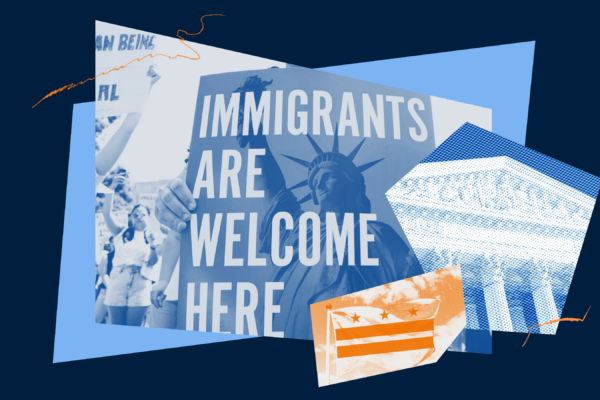
A collage showcasing an immigrants are welcome here sign with the statue of liberty, a District of Columbia flag in orange duotone, and an image of the supreme court.

Immigrants' Rights and Resources Hub

Regardless of your immigration status, you have guaranteed rights.
Know Your Rights
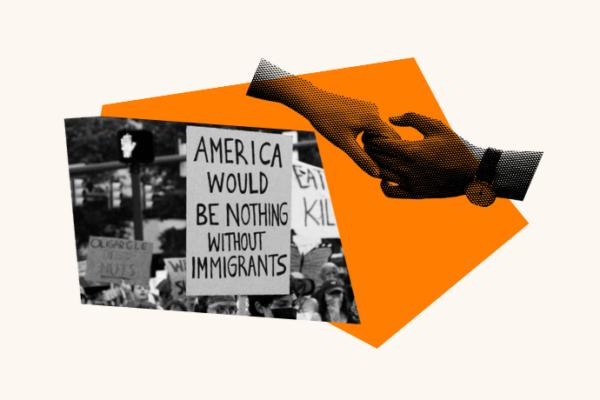
A black‑and‑white photo of a protest crowd holding a sign that reads “America would be nothing without immigrants,” overlaid with an orange geometric shape and a stylized illustration of two hands reaching toward each other.

تعرف على حقوقك عند الاحتكاك بإدارة الهجرة والجمارك (ICE) في منطقة العاصمة واشنطن الكبرى (DMV)

لكن حقوقك لا تتغير عندما تعبر هذه الحدود.
Press Release
Placeholder image

Immigrants and U.S. Citizens Sue DHS over Unconstitutional “Home Entry” Policy

Lawsuit alleges that DHS and ICE violated the Fourth Amendment rights of immigrants and U.S. citizens by secretly instructing agents to enter homes without a warrant
Know Your Rights
A black‑and‑white photo of a protest crowd holding a sign that reads “America would be nothing without immigrants,” overlaid with an orange geometric shape and a stylized illustration of two hands reaching toward each other.

Conozca sus derechos al interactuar con el ICE en el DMV

Sus derechos NO cambian cuando traspasa esos límites.
Court Case
Mar 30, 2026

Coalition for Humane Immigrant Rights v. Mullin – Challenging Government’s Secretive Elimination of Salient Safeguards in Expedited Removal Procedures

This case challenges the Trump administration’s secretive elimination of bedrock safeguards from the expedited removal process, a fast-track deportation procedure. Since 1997, when the expedited removal system was first put into practice, immigration officials were required to advise all noncitizens of their right to seek protection from persecution and torture and to ask all noncitizens if they fear being removed. These requirements reflected the United States’ non-refoulment treaty obligations not to remove noncitizens to countries where they could fear persecution or torture, and were reflected in specific forms immigration officials use during expedited removal, Forms I-867A and I-867B (collectively, “Form I-867”). Given the importance of these safeguards, courts have invalidated prior attempts by the government to summarily deport noncitizens without providing them notice and an opportunity to seek protection. Yet in February 2025, the Trump administration adopted a Revised Form I-867 that eliminated the fear advisal and questions. It adopted this revised form without any public notice or announcement at the time. It was not until January 29, 2026 that the government first announced in a court filing that it had quietly adopted this revised version of the Form nearly a year earlier. Together with the National ACLU, we filed this case in the federal district court in D.C. on behalf of non-profit organizations that have noncitizens as members and individual noncitizens seeking relief from Revised Form I-867. We allege that the Revised Form is unlawful because it violates the Due Process Clause under the Fifth Amendment to the Constitution and various provisions of the Administrative Procedure Act. We are asking the court to, among other things, vacate the Revised Form I-867, enjoin the government from employing the Revised Form, and order the government to return the individual noncitizen plaintiffs who were summarily removed pursuant to the unlawful Revised Form to the United States, parole them into the country, and allow them the opportunity to seek immigration relief.  
Court Case
May 22, 2026

Common Cause v. DOJ – Seeking to Block the Trump Administration’s Effort to Control Voter Registration Lists

The U.S. Department of Justice has launched an illegal and unprecedented quest to stockpile millions of Americans’ confidential voter data. DOJ has demanded that nearly every state and the District of Columbia turn over their unredacted statewide voter registration lists, which can include sensitive personal information such as Social Security numbers, driver’s license numbers, signatures, dates of birth, home addresses, places of birth, political party affiliation, and voter participation history. Never before has a federal agency centralized this volume of Americans’ voting data in a single record system. And in doing so, DOJ has flouted legal safeguards designed to ensure transparency and public participation in the federal government’s collection of Americans’ personal information. DOJ’s apparent purpose in collecting this data is to conduct its own state-by-state voter list maintenance operation and compel states to purge eligible voters from their voter rolls as part of the Trump Administration’s attempts to take over elections from states and subvert the 2026 midterm elections. DOJ is using this highly sensitive data to build—without Congressional authorization—a sprawling new voter surveillance and purging system that endangers millions of Americans’ fundamental voting and privacy rights. Heeding President Trump’s repeated calls to “take over” and “nationalize” elections, DOJ is now compiling these state voter files in order to create a national voter registration record system. DOJ is moving rapidly to interfere with the States’ lawful authority over elections and impose its own secretive “verification procedures” for identifying “ineligible voters” and then requiring states to remove those individuals from their voter rolls. DOJ has told federal courts and state officials that it will run states’ entire voter registration lists through the Department of Homeland Security’s flawed Systematic Alien Verification for Entitlements (“SAVE”) system. In 2025, DHS haphazardly expanded SAVE—which was previously a limited tool to determine eligibility for certain benefits—to conduct mass “voter verification” citizenship checks using unreliable data. The faulty new system has already falsely identified significant numbers of U.S. citizens as non-citizens, endangering their fundamental right to vote. And the system has proven especially unreliable for citizens born outside of the United States (e.g., naturalized citizens), who are at great risk of being falsely identified as non-citizens. Centralizing hundreds of millions of Americans’ state-level voter data in a single federal system also presents major cybersecurity risks, creating a new target for hackers and foreign actors who seek to undermine our elections and Americans’ data security. In addition to making bulk disclosures to DHS, DOJ plans to disclose voter registration lists data to unidentified private “contractors” to assist with its “list maintenance verification procedures.” Most states have resisted DOJ’s unprecedented data demands. But at least 12 and, according to DOJ, as many as 19 states have acquiesced to DOJ’s demands for their Confidential Voter Lists, including Alaska, Arkansas, Indiana, Kansas, Louisiana, Mississippi, Nebraska, Ohio, Oklahoma, South Dakota, Tennessee, Texas, and Wyoming. These states have disregarded the privacy and voting rights of millions of Americans who never consented to disclosing their sensitive personal data to the federal government for undefined purposes and without statutory authorization. On April 21, together with the National ACLU’s Voting Rights Project, Citizens for Responsibility and Ethics in Washington, Protect Democracy Project, and the Democracy and Rule of Law Clinic at Harvard Law School, we filed this lawsuit on behalf of Common Cause, an organization dedicated to upholding the core values of American democracy, and four of its individual members, to block the Trump Administration’s unlawful efforts to invade voters’ privacy and subvert our democratic elections. On April 19, we filed a motion for partial summary judgment, asking the court to rule that the government’s plan violated several federal statutes and to order DOJ to cease collecting and using this voter information and to delete what it has already obtained.
Court Case
Apr 20, 2026

Gibson Brown v. Mullin – Defending the Right to Privacy in the Home

Our homes are our sanctuaries, which is why, absent rare exceptions, the Fourth Amendment requires government officials to get a neutral judge’s permission through a warrant before entering. This basic principle governs every police department in the country. But now, the Department of Homeland Security has authorized its agents, including ICE, to ignore it. In a secret memo, made public by a whistleblower, DHS purported to authorize its officers to forcibly enter any home if a DHS official—not an independent judge—concludes that an individual inside is subject to a final order of removal. Under this policy, DHS can enter homes and make arrests on its own say-so—even if the target of the final removal order has rights to seek further review or resides with people who are not subject to deportation. Last December, DHS entered Abdulkadir Sharif Abdi’s home without a warrant, acting on an administrative form alone. Agents arrested him and detained him for 23 days until a federal judge ordered his release. Operating under the same sort of authority, DHS used a battering ram to enter the home of Teyana and Garrison Gibson Brown a few weeks later and then stormed into Noe Alfredo Salguero’s home after that. DHS officials have engaged in similar conduct around the country. On April 2, we joined a coalition of legal organizations to file a lawsuit challenging DHS’s policy of authorizing agents to enter homes without judicially signed warrants.
Court Case
Apr 14, 2026

Carvajal-Muñoz v. Ravencamp – Seeking Accountability for Violent Abduction of Lawful Immigrant by Federal Agents

People in the United States have the right to go about their daily lives without being suddenly and violently abducted because of their skin color or ethnicity, or for no reason at all. This suit seeks to vindicate that right and to redress grave constitutional violations. Juan Sebastián Carvajal-Muñoz (“Sebastián”) moved to Maine from Colombia on a student visa to earn his master’s degree in civil engineering at the University of Maine. He then accepted a job as a civil engineer, specializing in conducting soil and foundation analyses for bridge construction across Maine. He was invited to stay in the United States under the H-1B visa program, which permits noncitizens to work legally in the U.S. if they can “perform services of exceptional merit and ability.” On the morning of January 22, 2026, during the federal government’s “Operation Catch of the Day” immigration crackdown in Maine, armed federal agents abducted Sebastián while he was driving to work. They cut in front of Sebastián’s car, bashed in his window, dragged him out of the car, handcuffed him, and left his car running in the middle of the street in downtown Portland. Sebastián offered proof of his lawful immigration status. Yet the agents told Sebastián that his visa would be revoked and placed him in full-body shackles. Agents then drove Sebastián around for hours, refused to release him despite instruction to do so, and instead locked him in a windowless cell in an ICE facility in Massachusetts. As abruptly as the agents had abducted him, they released him in Burlington, Massachusetts, after 9 p.m. that night, leaving him to find his way back home. The agents’ actions were unconstitutional for multiple reasons. First, federal agents stopped Sebastián without any reasonable suspicion that he was in the country unlawfully or had committed any other offense. Second, federal agents arrested him without a warrant and without probable cause to believe he was removable, ignoring proffered proof that he had lawful immigration status. Third, federal agents engaged in discrimination, arresting Sebastián for no reason other than his apparent race, skin color, or ethnicity. Fourth, federal agents used unreasonable force and violence against Sebastián, pointlessly breaking his car window, dragging him from his car, and placing him in full-body shackles. And fifth, independent of the unlawfulness of the seizure at its inception, the length of time agents kept Sebastián detained was likewise unreasonable and unconstitutional. The federal agents’ conduct violated the constitutional guarantees of equal protection and freedom from unreasonable search and seizure under the Fourth and Fifth Amendments. The federal agents’ conduct toward Sebastián is consistent with DHS’s broader campaign of conducting mass immigration arrests without a warrant or any lawful basis. DHS’s dragnet ensnares noncitizens based solely on their race, skin color or ethnicity, including individuals like Sebastián with lawful immigration status. These brutal stops and arrests terrorize immigrant communities and disrupt even the most ordinary of activities—working, going to school, shopping, driving. In addition to vindicating Sebastián's rights and compensating him for the physical and emotional harms he has suffered, this case is important to try to reestablish a critical path to holding federal officers accountable for constitutional violations. In 1971, the Supreme Court held that people could sue directly under the Constitution when federal officers violated their rights, but in 2017, the Supreme Court dramatically narrowed the ability of such cases to proceed—creating a huge and alarming accountability gap between federal and state officers. For example, after Minneapolis Police Officer Derek Chauvin murdered George Floyd in 2020, Mr. Floyd’s family sued the City of Minneapolis and police officers for violating his constitutional rights, ultimately securing a $27 million settlement. By contrast, following the recent Supreme Court's turn against federal-officer accountability, federal law does not allow the families of Alex Pretti and Renee Good to file that same type of lawsuit against the federal agents who shot and killed them just miles from where Mr. Floyd was murdered. Historically, people could use state law to sue federal officers for wrongdoing. We believe that state law could once again play that role, closing up the accountability gap that the Supreme Court has created. The Maine Civil Rights Act is one of the most promising state laws currently on the books that could do so, so we have invoked it in Sebastián's case. When federal agents face no consequences, that impunity invites more wrongdoing, turns our freedoms into empty promises, and leaves us all unprotected. U.S. courts have long recognized the fundamental legal principle that where there is a right, there must be a remedy. We hope this case will help make good on that promise and expand people's ability to seek justice when the federal government violates their constitutional rights.