Court Cases
Featured Cases
Jun 25, 2026

O’Hara v. Beck – Defending the Right To Protest the National Guard
In Star Wars, the Imperial March is the music that plays when Darth Vader and his storm troopers enter the scene. It’s also the soundtrack of Sam O’Hara’s protest against the National Guard’s presence in D.C.
National Guard troops arrived in the District after President Donald Trump deployed them to support local police—an act that Mr. O’Hara views as a violation of centuries-old norms against militarizing domestic law enforcement and a threat to individual freedom.
To highlight the surreal danger of the deployment, Mr. O’Hara began walking behind Guard members when he saw them in the community, playing The Imperial March on his phone, and recording. Most community members got the point of the protest, and so did several members of the Guard, who either smiled or laughed in response.
Ohio National Guard Sgt. Devon Beck, however, was not amused by the satire. He threatened to call MPD if Mr. O’Hara didn’t stop his protest. When Mr. O’Hara persisted, Sgt. Beck recruited MPD officers to the scene, and the officers proceeded to detain and handcuff Mr. O’Hara, ending his demonstration.
The First and Fourth Amendments (not to mention D.C. law) bar government officials from detaining people just because of their speech. Mr. O’Hara is suing to vindicate that principle.
Sgt. Beck moved to dismiss the claims against him, arguing among other things that he is entitled to the defense of qualified immunity because he did not violate rights that were “clearly established.” That motion remains pending.
Meanwhile, in June 2026, the remaining defendants — the D.C. government and its officers — agreed to compensate Mr. O’Hara in exchange for dismissal of the claims against them.
Press Release
Jan 12, 2026

Fell v. Trump (formerly Stainnak v. Trump) – Challenging Purge of DEI-Associated Federal Workers As Discriminatory and Retaliatory for Perceived Political Beliefs
Federal employees filed a complaint against the Trump administration for targeting workers, especially people of color, women, and non-binary workers, for participating in diversity, equity, and inclusion (DEI) activities, violating their First Amendment rights.
Mar 4, 2026
Escobar Molina v. Dep’t of Homeland Security – Challenging Warrantless Immigration Arrests Without Probable Cause in D.C.
On September 25, 2025, four Washington, D.C. community members and the national immigration organization CASA sued the Trump administration to end its policy and practice of making immigration arrests in D.C. without a warrant and without probable cause. The plaintiffs are represented by the American Civil Liberties Union of the District of Columbia, American Civil Liberties Union, Amica Center for Immigrants’ Rights, CASA, National Immigration Project, the Washington Lawyers’ Committee for Civil Rights and Urban Affairs, and the law firm of Covington & Burling.
Since August, federal officers from multiple agencies have made hundreds of immigration arrests in the District. The officers frequently patrol and set up checkpoints in neighborhoods where a large number of immigrants live and stop and arrest people as they go about their daily lives.
The law typically requires an agent to have a warrant when arresting someone for an immigration violation. One exception to the warrant requirement is when the agent has probable cause both that a person is in the United States in violation of the law and is likely to escape before a warrant can be obtained.
According to the lawsuit, the Trump administration has a policy and practice of making immigration arrests without a warrant and without an individualized determination of probable cause that the person is in the country unlawfully and that the person is a flight risk.
Each plaintiff in the case was arrested, detained, and released. The lawsuit was filed as a class action. The plaintiffs seek a court ruling to prevent the government from conducting such unlawful arrests against them and others in the future.
On October 3, 2025, Plaintiffs filed a motion for class certification and a motion for a preliminary injunction, to stay agency action, and for provisional class certification to ask the Court to order Defendants and their agents to stop making warrantless immigration arrests without probable cause for flight risk, as required by the Immigration and Nationality Act.
On November 19, 2025, the district court heard oral argument on Plaintiffs’ motions. On December 2, 2025, the district court denied without prejudice Plaintiffs’ motion for class certification and granted in part and denied in part Plaintiffs’ motion for a preliminary injunction, to stay agency action, and for provisional class certification. It issued an order preliminarily enjoining the government from enforcing its policy or practice of making warrantless civil immigration arrests in D.C. without a pre-arrest individualized determination by the arresting agent of probable cause that the person being arrested is likely to escape before a warrant can be obtained. It also provisionally certified a class consisting of “[a]ll persons who, since August 11, 2025, have been or will be arrested in this District for alleged immigration violations without a warrant and without a pre-arrest, individualized assessment of probable cause that the person poses an escape risk” for purposes of the preliminary injunction. The court further ordered the government to document the facts supporting an arresting agent’s probable cause to believe a person is likely to escape before a warrant can be obtained and to periodically provide such documentation to Plaintiffs’ counsel.
On February 19, 2025, Plaintiffs filed a motion to enforce the preliminary injunction, arguing that Defendants are not complying with the preliminary injunction based on the arrest records they produced for warrantless civil immigration arrests in D.C. after the district court’s December 2 order as well as recent public statements made by high-ranking DHS officials on the legal standard for arrests and an internal ICE memorandum that was issued on January 28. The relief Plaintiffs seek includes training for Defendants’ agents on the correct legal standard to apply when making warrantless civil immigration arrests and additional reporting requirements regarding warrantless civil immigration arrests in D.C. The district court has set argument on the motion for March 11 at 10:00AM.
Following the hearing on March 11, both parties submitted supplemental briefing focused on the January 28th ICE memorandum, arguing that the memo misinterprets the probable cause standard for escape risk and asking the court to order Defendants not to rely on the probable cause standard or analysis in the memo. On May 7, 2026, the district court granted Plaintiffs’ motion and ordered that “when conducting civil immigration arrests without a warrant in this District, defendants shall not rely on the probable cause standard or analytical approach set forth in the five-page memorandum from former Acting Director of Immigration and Customs Enforcement, Todd Lyons[.]”
All Cases
298 Court Cases
Oct 23, 2026
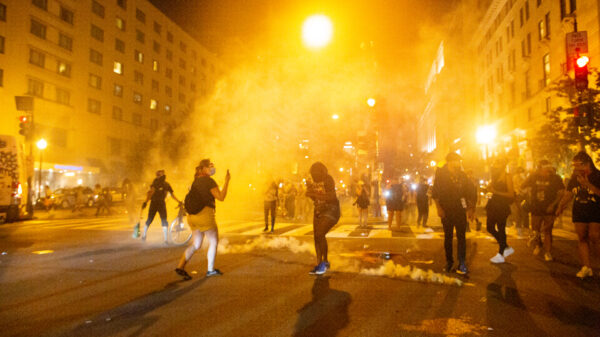
Asinor v. District of Columbia – Challenging Use of Chemical Irritants and Less-Lethal Projectiles Against Demonstrators and Journalists
The ACLU-DC filed a lawsuit on behalf of two photojournalists against the District of Columbia and 8 D.C. Metropolitan Police Department officers for unleashing chemical irritants and stun grenades one month after the D.C. Council instilled a ban on the use of these weapons during demonstrations.
Oct 23, 2026
Cameron v. District of Columbia – Challenging Practice of Needlessly Retaining Arrested Individuals’ Cell Phones for Months or Years Without Process
Oct 23, 2026
Withrow v. United States: Challenging Ban on Transgender and Intersex Federal Employees’ Ability To Use Bathroom That Accords with Their Gender Identity
Oct 23, 2026
League of Women Voters Educ. Fund v. Trump (A.K.A. LULAC v. Exec. Office of the President) – Challenging Executive Order Requiring Voters To Show Citizenship Documents To Register
This case challenges President Trump’s attempt to require burdensome documentation to register to vote—a requirement that he lacks authority to impose and that will obstruct many voters’ efforts to register.
Under the National Voter Registration Act of 1993 (“NVRA”) and the Help America Vote Act of 2002, Congress created a voter registration form (the “Federal Form”) that each state must accept. Regardless of the contents of State voter registration forms, the Federal Form (as the Supreme Court has explained) “provides a backstop” that “guarantees . . . a simple means of registering to vote in federal elections will be available.”
Congress created a bipartisan, independent Election Assistance Commission (“EAC”) to maintain the Federal Form and consider changes—which can be made, according to the statute, only through notice-and-comment rulemaking and not by EAC members of a single party acting alone. Congress set strict requirement about what the Federal Form must and may not include. Every person who registers using the Federal Form must swear under penalty of perjury that they are a U.S. citizen. But Congress prohibited “any requirement for notarization or other formal authentication.” Congress further authorized the EAC to require “identifying information” and “other information” on the Federal Form only if the information “is necessary to enable the appropriate State election official to assess the eligibility of the applicant and to administer voter registration and other parts of the election process.”
On March 25, 2024, President Trump issued an Executive Order instructing the EAC within 30 days to change the Federal Form to require that voters, in order to register, show documents proving their citizenship.
But when Congress passed the NVRA in 1993, it had specifically considered and rejected adding such a requirement to the Federal Form. Since then, the EAC has repeatedly rejected requests to add such a requirement. And with good reason: many citizens lack the types of documentation that would suffice. For instance, roughly half of Americans, including more than two-thirds of Black Americans, lack a valid passport; obtaining one is costly and can take months. Birth certificates pose challenges, too: according to one survey, one third of voting-age women lack documentary proof of citizenship that reflects their current name (because many change their names when they marry); additionally, many of the roughly 1.3 million transgender Americans have changed their legal names, and some Americans—especially Black citizens—never received a birth certificate because of racially discriminatory laws.
More fundamentally, President Trump lacks authority to order changes to the Federal Form or to direct the actions of the EAC, an agency set up by Congress to be independent. The Constitution’s Elections Clause vests Congress and the States—not the President—with authority to set rules for federal elections. Congress exercised this authority when it passed the NVRA. In acting contrary to that law, the President violates the separation of powers.
On April 1, 2025, together with our co-counsel at the National ACLU, Brennan Center for Justice, NAACP Legal Defense and Education Fund, Latino Justice PRLDEF, and Asian Americans Advancing Justice, we challenged the Executive Order in federal court on behalf of the League of Women Voters and several other voting rights organizations. In light of the short deadline for the EAC to act, and with the required changes likely to affect voter-registration efforts by our clients in advance of a federal special election coming up in July 2025 in Arizona, we sought a preliminary injunction.
Two other sets of plaintiffs sued as well, and the cases were consolidated; the case became known by one of the other case names, League of United Latin American Citizens (LULAC) v. Executive Office of the President.
On April 24, 2025, the day on which the EAC was required to change the form, the court issued a preliminary injunction blocking the EAC from imposing a documentary proof of citizenship requirement because the President’s command that it do so violates the separation of powers. The court’s thorough, 120-page opinion rejected the government’s arguments that the case was premature and that our clients lacked standing to challenge the Executive Order, and the court held that the President lacked authority under the NVRA or the Constitution to impose a documentary proof of citizenship requirement: “If the President, acting alone, could dictate the content of the Federal Form, Congress’s careful structural choices would be for naught. . . .
No statute expressly or impliedly grants the President authority to require documentary proof of citizenship on the Federal Form. Nor does any provision of the Constitution vest the President with that authority.”
After the court entered the preliminary injunction, Plaintiffs moved for a permanent one and the court granted that relief as well. In response to dueling motions for partial summary judgment, the court held that provisions of the Executive Order that “purport[] to impose new requirements for verifying the U.S. citizenship of people registering to vote or applying to receive absentee ballots” were unconstitutional and enjoined their enforcement. The government appealed that decision to the D.C. Circuit, where it is currently pending.
Oct 13, 2026
Gonzalez v. U.S. Department of Homeland Security – Challenging ICE’s de facto policy of failing to return property seized from people in civil immigration detention
When the government obtains someone’s property, it must return those items when its interest in them expires, even if it initially took control of the items lawfully. This means that if the government seizes a person’s property incident to an arrest, it must return the items that are not contraband, not evidence, and not needed for some other legitimate governmental purpose. The Fourth Amendment requires nothing less. And, when it’s the federal government that obtains someone’s property, the Administrative Procedure Act’s ban on arbitrary and capricious conduct imposes the same mandate.
ICE routinely flouts this obligation. It has adopted what amounts to a de facto policy of failing to return property seized from people it detained for civil immigration purposes long after any plausible governmental interest in the items expired. This case challenges ICE’s conduct on behalf of seven people and a class of similarly situated individuals. The named plaintiffs were all detained in ICE custody, stripped of important property, and still have not received all their items at least four months after their release. ICE failed to return Employment Authorization Documents and other important documents, along with items such as cell phones and car keys. As a result, the plaintiffs have lost work opportunities, feared going out in public (because they don’t have identification, which could lead ICE to detain them again), and suffered other forms of personal and economic hardship.
The plaintiffs bring this case to regain the items ICE withheld from them and ensure that the agency comports with its legal duties when handling property in the future.
Oct 8, 2026
Mathis v. U.S. Parole Commission – Challenging Failure to Accommodate People’s Disabilities in Setting Conditions of Parole and Supervised Release
Oct 7, 2026
Block Club Chicago v. Department of Homeland Security
In the first 10 days of the second Trump administration, Chicago was “ground zero” for a massive ICE operation that arrested hundreds of people. They were dubbed “the worst of the worst” by ICE, but the agency only released names and criminal histories of those they chose to publicize, keeping the others secret.
A media outlet called Block Club Chicago filed a Freedom of Information Act request for the names and other details about the people who had been arrested. The Department of Homeland Security (of which ICE is a part) denied the request. Block Club filed a lawsuit here in D.C., but the district court accepted ICE’s argument that the arrestees’ privacy interests in remaining unknown were stronger than the public’s right to know who ICE had seized and detained.
Block Club appealed, and on October 5, 2026, we filed an amicus brief showing that secret arrests are a tool of authoritarian government, and are anathema in a free country, as explained by Alexander Hamilton in Federalist 84 and as confirmed by 250 years of U.S. history in which “police blotter” information has always been a public record.
Oral argument in the court of appeals has not yet been scheduled.
Oct 2, 2026
Nielsen v. Watanabe – Fighting for the Right To Seek Redress for Constitutional Violations by Federal Prison Officers
Kekai Watanabe was brutally attacked in a prison fight and his tailbone was broken. For months, prison staff at the federal prison in Hawai‘i where he was detained denied his requests for hospital care, providing him instead with over-the-counter pain medication. Mr. Watanabe sued, seeking damages for his months of pain and suffering. Doing so is his only way to hold accountable the officials who ignored his repeated requests for care.
But the government now argues that he has no right to sue a federal prison official. Although state and local officers who violate the Constitution in this same way could be sued for it, there’s no federal law specifically creating a right to sue federal officers for constitutional violations, and so the government argues such suits cannot proceed. Using this type of reasoning, the Supreme Court in recent years has made it extremely difficult to sue federal officers.
This rule creates a major gap in constitutional enforcement, especially here in D.C., where there is a huge federal law enforcement presence. Because of the Supreme Court’s hostility toward claims against federal officers, for instance, our case seeking damages for the massive, unprovoked assault on peaceful civil rights demonstrators at Lafayette Square in the summer of 2020 is proceeding on very different terms against the federal officers than against the local officers involved in the same incident: whereas against the D.C. police we have been allowed to proceed as a class action and will be able to seek punitive damages, we could proceed only on behalf of a handful of individuals (not a class) for constitutional violations by the U.S. Park Police, Secret Service, and other federal defendants like former Attorney General William Barr, and we cannot seek punitive damages for the federal offers’ violations.
Together with the National ACLU and the ACLU of Hawai‘i, we filed a friend-of-the-court brief in support of Mr. Watanabe at the Supreme Court. Even the Court’s restrictive recent decisions about suing federal officers acknowledge that Congress, in the Westfall Act of 1988, preserved the ability to bring some federal officer claims. When Congress legislates about a well-established legal concept, courts presume that Congress intended to incorporate that established meaning. At the time of the Westfall Act’s passage, courts permitted claims—like Mr. Watanabe’s—alleging unconstitutionally deficient prison medical care by federal officers. Therefore, to respect the instructions of Congress, the courts should continue to permit such claims today.
A contrary result would be disastrous, and not just for Mr. Watanabe. One of the government’s main arguments here is that a federal-officer suit cannot proceed because federal prisons have an internal grievance process, known as the “ARP.” When appeals courts have applied this ahistorical limitation on what federal-officer suits are available, the results have been grotesque. For instance, the Eleventh Circuit recently relied on the ARP to reject a constitutional claim for fatally inadequate medical treatment of Hepatitis C in prison “even though [the plaintiff’s] estate could not use the ARP after his death.” Carrin v. Strong, 182 F.4th 1351, 1354 (11th Cir. 2026). The Third Circuit relied on the ARP to reject a constitutional claim for the failure to treat diabetic blisters that ultimately required the amputation of the plaintiff’s toe, even though the “effectiveness” of the ARP was “dubious.” Muniz v. United States, 149 F.4th 256, 258, 264 (3d Cir. 2025). And the Eleventh Circuit relied on the ARP in rejecting a constitutional claim for failure to treat an incarcerated plaintiff’s “severe but ultimately non-lethal physical injuries” even though “the district court found that he was denied access to the [ARP].” Johnson v. Terry, 119 F.4th 840, 858-60 (11th Cir. 2024). These outcomes are both unfair and contrary to what Congress directed when it acted in 1988.
The Supreme Court will hear argument in this case November 9.
Sep 30, 2026
CNN v. Trump – Challenging the President’s Decision To Ban from the White House News Outlets Whose Reporting He Doesn’t Like
Once again, the Trump Administration is attempting to exert unconstitutional control over the content of expression—this time, by banning from the White House news organizations whose reporting has displeased the President. This unconstitutional ban follows previous violations of press freedom by the Administration, including restricting the Associated Press’s access to official events after the outlet refused to adopt the Administration’s preferred name for the Gulf of Mexico, and the government’s crackdown on press access to the Pentagon by those who would not agree to report only official handouts. (We filed amicus briefs in both those cases, also.)
So once again, we (together with the National ACLU) are filing an amicus brief in support of the media’s First Amendment right to report as they see fit without governmental retaliation for news coverage the President doesn’t like. The President’s assertion of the power to banish journalists for disfavored coverage is an alarming part of a broader assault on free expression. The Administration has attempted to muzzle institutions like the bar, the academy, and the media that are at the heart of civil society and has retaliated against speakers of all kinds for espousing views the Administration dislikes. Our Nation’s history and other countries’ modern trajectories demonstrate the importance of upholding First Amendment protections here. When officials are allowed to punish media organizations for their reporting, repression and democratic backsliding often follow.
Stay Informed
Sign up to be the first to hear about how to take action.
By completing this form, I agree to receive occasional emails per the terms of the ACLU’s privacy statement.
By completing this form, I agree to receive occasional emails per the terms of the ACLU’s privacy statement.