Court Cases
Featured Cases
Jun 25, 2026
O’Hara v. Beck – Defending the Right To Protest the National Guard
In Star Wars, the Imperial March is the music that plays when Darth Vader and his storm troopers enter the scene. It’s also the soundtrack of Sam O’Hara’s protest against the National Guard’s presence in D.C.
National Guard troops arrived in the District after President Donald Trump deployed them to support local police—an act that Mr. O’Hara views as a violation of centuries-old norms against militarizing domestic law enforcement and a threat to individual freedom.
To highlight the surreal danger of the deployment, Mr. O’Hara began walking behind Guard members when he saw them in the community, playing The Imperial March on his phone, and recording. Most community members got the point of the protest, and so did several members of the Guard, who either smiled or laughed in response.
Ohio National Guard Sgt. Devon Beck, however, was not amused by the satire. He threatened to call MPD if Mr. O’Hara didn’t stop his protest. When Mr. O’Hara persisted, Sgt. Beck recruited MPD officers to the scene, and the officers proceeded to detain and handcuff Mr. O’Hara, ending his demonstration.
The First and Fourth Amendments (not to mention D.C. law) bar government officials from detaining people just because of their speech. Mr. O’Hara is suing to vindicate that principle.
Sgt. Beck moved to dismiss the claims against him, arguing among other things that he is entitled to the defense of qualified immunity because he did not violate rights that were "clearly established." That motion remains pending.
Meanwhile, in June 2026, the remaining defendants — the D.C. government and its officers — agreed to compensate Mr. O'Hara in exchange for dismissal of the claims against them.
Press Release
Mar 4, 2026
Escobar Molina v. Dep’t of Homeland Security – Challenging Warrantless Immigration Arrests Without Probable Cause in D.C.
On September 25, 2025, four Washington, D.C. community members and the national immigration organization CASA sued the Trump administration to end its policy and practice of making immigration arrests in D.C. without a warrant and without probable cause. The plaintiffs are represented by the American Civil Liberties Union of the District of Columbia, American Civil Liberties Union, Amica Center for Immigrants’ Rights, CASA, National Immigration Project, the Washington Lawyers’ Committee for Civil Rights and Urban Affairs, and the law firm of Covington & Burling.
Since August, federal officers from multiple agencies have made hundreds of immigration arrests in the District. The officers frequently patrol and set up checkpoints in neighborhoods where a large number of immigrants live and stop and arrest people as they go about their daily lives.
The law typically requires an agent to have a warrant when arresting someone for an immigration violation. One exception to the warrant requirement is when the agent has probable cause both that a person is in the United States in violation of the law and is likely to escape before a warrant can be obtained.
According to the lawsuit, the Trump administration has a policy and practice of making immigration arrests without a warrant and without an individualized determination of probable cause that the person is in the country unlawfully and that the person is a flight risk.
Each plaintiff in the case was arrested, detained, and released. The lawsuit was filed as a class action. The plaintiffs seek a court ruling to prevent the government from conducting such unlawful arrests against them and others in the future.
On October 3, 2025, Plaintiffs filed a motion for class certification and a motion for a preliminary injunction, to stay agency action, and for provisional class certification to ask the Court to order Defendants and their agents to stop making warrantless immigration arrests without probable cause for flight risk, as required by the Immigration and Nationality Act.
On November 19, 2025, the district court heard oral argument on Plaintiffs’ motions. On December 2, 2025, the district court denied without prejudice Plaintiffs’ motion for class certification and granted in part and denied in part Plaintiffs’ motion for a preliminary injunction, to stay agency action, and for provisional class certification. It issued an order preliminarily enjoining the government from enforcing its policy or practice of making warrantless civil immigration arrests in D.C. without a pre-arrest individualized determination by the arresting agent of probable cause that the person being arrested is likely to escape before a warrant can be obtained. It also provisionally certified a class consisting of “[a]ll persons who, since August 11, 2025, have been or will be arrested in this District for alleged immigration violations without a warrant and without a pre-arrest, individualized assessment of probable cause that the person poses an escape risk” for purposes of the preliminary injunction. The court further ordered the government to document the facts supporting an arresting agent’s probable cause to believe a person is likely to escape before a warrant can be obtained and to periodically provide such documentation to Plaintiffs’ counsel.
On February 19, 2025, Plaintiffs filed a motion to enforce the preliminary injunction, arguing that Defendants are not complying with the preliminary injunction based on the arrest records they produced for warrantless civil immigration arrests in D.C. after the district court’s December 2 order as well as recent public statements made by high-ranking DHS officials on the legal standard for arrests and an internal ICE memorandum that was issued on January 28. The relief Plaintiffs seek includes training for Defendants’ agents on the correct legal standard to apply when making warrantless civil immigration arrests and additional reporting requirements regarding warrantless civil immigration arrests in D.C. The district court has set argument on the motion for March 11 at 10:00AM.
Following the hearing on March 11, both parties submitted supplemental briefing focused on the January 28th ICE memorandum, arguing that the memo misinterprets the probable cause standard for escape risk and asking the court to order Defendants not to rely on the probable cause standard or analysis in the memo. On May 7, 2026, the district court granted Plaintiffs' motion and ordered that “when conducting civil immigration arrests without a warrant in this District, defendants shall not rely on the probable cause standard or analytical approach set forth in the five-page memorandum from former Acting Director of Immigration and Customs Enforcement, Todd Lyons[.]”
All Cases
41 Court Cases
Oct 21, 2026
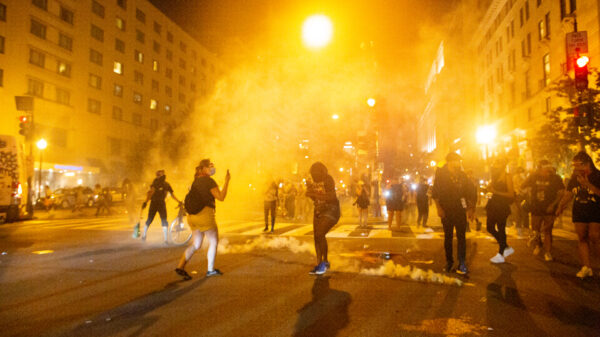
Asinor v. District of Columbia – Challenging Use of Chemical Irritants and Less-Lethal Projectiles Against Demonstrators and Journalists
The ACLU-DC filed a lawsuit on behalf of two photojournalists against the District of Columbia and 8 D.C. Metropolitan Police Department officers for unleashing chemical irritants and stun grenades one month after the D.C. Council instilled a ban on the use of these weapons during demonstrations.
Oct 21, 2026
Cameron v. District of Columbia – Challenging Practice of Needlessly Retaining Arrested Individuals' Cell Phones for Months or Years Without Process
Oct 2, 2026
Nielsen v. Watanabe – Fighting for the Right To Seek Redress for Constitutional Violations by Federal Prison Officers
Kekai Watanabe was brutally attacked in a prison fight and his tailbone was broken. For months, prison staff at the federal prison in Hawai‘i where he was detained denied his requests for hospital care, providing him instead with over-the-counter pain medication. Mr. Watanabe sued, seeking damages for his months of pain and suffering. Doing so is his only way to hold accountable the officials who ignored his repeated requests for care.
But the government now argues that he has no right to sue a federal prison official. Although state and local officers who violate the Constitution in this same way could be sued for it, there's no federal law specifically creating a right to sue federal officers for constitutional violations, and so the government argues such suits cannot proceed. Using this type of reasoning, the Supreme Court in recent years has made it extremely difficult to sue federal officers.
This rule creates a major gap in constitutional enforcement, especially here in D.C., where there is a huge federal law enforcement presence. Because of the Supreme Court's hostility toward claims against federal officers, for instance, our case seeking damages for the massive, unprovoked assault on peaceful civil rights demonstrators at Lafayette Square in the summer of 2020 is proceeding on very different terms against the federal officers than against the local officers involved in the same incident: whereas against the D.C. police we have been allowed to proceed as a class action and will be able to seek punitive damages, we could proceed only on behalf of a handful of individuals (not a class) for constitutional violations by the U.S. Park Police, Secret Service, and other federal defendants like former Attorney General William Barr, and we cannot seek punitive damages for the federal offers' violations.
Together with the National ACLU and the ACLU of Hawai‘i, we filed a friend-of-the-court brief in support of Mr. Watanabe at the Supreme Court. Even the Court’s restrictive recent decisions about suing federal officers acknowledge that Congress, in the Westfall Act of 1988, preserved the ability to bring some federal officer claims. When Congress legislates about a well-established legal concept, courts presume that Congress intended to incorporate that established meaning. At the time of the Westfall Act’s passage, courts permitted claims—like Mr. Watanabe’s—alleging unconstitutionally deficient prison medical care by federal officers. Therefore, to respect the instructions of Congress, the courts should continue to permit such claims today.
A contrary result would be disastrous, and not just for Mr. Watanabe. One of the government’s main arguments here is that a federal-officer suit cannot proceed because federal prisons have an internal grievance process, known as the “ARP.” When appeals courts have applied this ahistorical limitation on what federal-officer suits are available, the results have been grotesque. For instance, the Eleventh Circuit recently relied on the ARP to reject a constitutional claim for fatally inadequate medical treatment of Hepatitis C in prison “even though [the plaintiff’s] estate could not use the ARP after his death.” Carrin v. Strong, 182 F.4th 1351, 1354 (11th Cir. 2026). The Third Circuit relied on the ARP to reject a constitutional claim for the failure to treat diabetic blisters that ultimately required the amputation of the plaintiff’s toe, even though the “effectiveness” of the ARP was “dubious.” Muniz v. United States, 149 F.4th 256, 258, 264 (3d Cir. 2025). And the Eleventh Circuit relied on the ARP in rejecting a constitutional claim for failure to treat an incarcerated plaintiff’s “severe but ultimately non-lethal physical injuries” even though “the district court found that he was denied access to the [ARP].” Johnson v. Terry, 119 F.4th 840, 858-60 (11th Cir. 2024). These outcomes are both unfair and contrary to what Congress directed when it acted in 1988.
The Supreme Court will hear argument in this case November 9.
Apr 20, 2026
Gibson Brown v. Mullin – Defending the Right to Privacy in the Home
Our homes are our sanctuaries, which is why, absent rare exceptions, the Fourth Amendment requires government officials to get a neutral judge’s permission through a warrant before entering. This basic principle governs every police department in the country. But now, the Department of Homeland Security has authorized its agents, including ICE, to ignore it. In a secret memo, made public by a whistleblower, DHS purported to authorize its officers to forcibly enter any home if a DHS official—not an independent judge—concludes that an individual inside is subject to a final order of removal. Under this policy, DHS can enter homes and make arrests on its own say-so—even if the target of the final removal order has rights to seek further review or resides with people who are not subject to deportation.
Last December, DHS entered Abdulkadir Sharif Abdi’s home without a warrant, acting on an administrative form alone. Agents arrested him and detained him for 23 days until a federal judge ordered his release. Operating under the same sort of authority, DHS used a battering ram to enter the home of Teyana and Garrison Gibson Brown a few weeks later and then stormed into Noe Alfredo Salguero’s home after that. DHS officials have engaged in similar conduct around the country.
On April 2, we joined a coalition of legal organizations to file a lawsuit challenging DHS’s policy of authorizing agents to enter homes without judicially signed warrants.
Apr 14, 2026
Carvajal-Muñoz v. Ravencamp – Seeking Accountability for Violent Abduction of Lawful Immigrant by Federal Agents
People in the United States have the right to go about their daily lives without being suddenly and violently abducted because of their skin color or ethnicity, or for no reason at all. This suit seeks to vindicate that right and to redress grave constitutional violations.
Juan Sebastián Carvajal-Muñoz (“Sebastián”) moved to Maine from Colombia on a student visa to earn his master’s degree in civil engineering at the University of Maine. He then accepted a job as a civil engineer, specializing in conducting soil and foundation analyses for bridge construction across Maine. He was invited to stay in the United States under the H-1B visa program, which permits noncitizens to work legally in the U.S. if they can “perform services of exceptional merit and ability.”
On the morning of January 22, 2026, during the federal government’s “Operation Catch of the Day” immigration crackdown in Maine, armed federal agents abducted Sebastián while he was driving to work. They cut in front of Sebastián’s car, bashed in his window, dragged him out of the car, handcuffed him, and left his car running in the middle of the street in downtown Portland.
Sebastián offered proof of his lawful immigration status. Yet the agents told Sebastián that his visa would be revoked and placed him in full-body shackles.
Agents then drove Sebastián around for hours, refused to release him despite instruction to do so, and instead locked him in a windowless cell in an ICE facility in Massachusetts. As abruptly as the agents had abducted him, they released him in Burlington, Massachusetts, after 9 p.m. that night, leaving him to find his way back home.
The agents’ actions were unconstitutional for multiple reasons. First, federal agents stopped Sebastián without any reasonable suspicion that he was in the country unlawfully or had committed any other offense. Second, federal agents arrested him without a warrant and without probable cause to believe he was removable, ignoring proffered proof that he had lawful immigration status. Third, federal agents engaged in discrimination, arresting Sebastián for no reason other than his apparent race, skin color, or ethnicity. Fourth, federal agents used unreasonable force and violence against Sebastián, pointlessly breaking his car window, dragging him from his car, and placing him in full-body shackles. And fifth, independent of the unlawfulness of the seizure at its inception, the length of time agents kept Sebastián detained was likewise unreasonable and unconstitutional. The federal agents’ conduct violated the constitutional guarantees of equal protection and freedom from unreasonable search and seizure under the Fourth and Fifth Amendments.
The federal agents’ conduct toward Sebastián is consistent with DHS’s broader campaign of conducting mass immigration arrests without a warrant or any lawful basis. DHS’s dragnet ensnares noncitizens based solely on their race, skin color or ethnicity, including individuals like Sebastián with lawful immigration status. These brutal stops and arrests terrorize immigrant communities and disrupt even the most ordinary of activities—working, going to school, shopping, driving.
In addition to vindicating Sebastián's rights and compensating him for the physical and emotional harms he has suffered, this case is important to try to reestablish a critical path to holding federal officers accountable for constitutional violations. In 1971, the Supreme Court held that people could sue directly under the Constitution when federal officers violated their rights, but in 2017, the Supreme Court dramatically narrowed the ability of such cases to proceed—creating a huge and alarming accountability gap between federal and state officers. For example, after Minneapolis Police Officer Derek Chauvin murdered George Floyd in 2020, Mr. Floyd’s family sued the City of Minneapolis and police officers for violating his constitutional rights, ultimately securing a $27 million settlement. By contrast, following the recent Supreme Court's turn against federal-officer accountability, federal law does not allow the families of Alex Pretti and Renee Good to file that same type of lawsuit against the federal agents who shot and killed them just miles from where Mr. Floyd was murdered.
Historically, people could use state law to sue federal officers for wrongdoing. We believe that state law could once again play that role, closing up the accountability gap that the Supreme Court has created. The Maine Civil Rights Act is one of the most promising state laws currently on the books that could do so, so we have invoked it in Sebastián's case.
When federal agents face no consequences, that impunity invites more wrongdoing, turns our freedoms into empty promises, and leaves us all unprotected. U.S. courts have long recognized the fundamental legal principle that where there is a right, there must be a remedy. We hope this case will help make good on that promise and expand people's ability to seek justice when the federal government violates their constitutional rights.
Jul 29, 2025
Black Lives Matter D.C. v. Trump – Challenging Federal Officers’ Unprovoked Attack on Civil Rights Demonstrators at Lafayette Square in Front of the White House
A coalition of civil rights orgs sued President Trump and high-level officials for tear-gassing protesters outside the White House on June 1, 2020.
Jul 25, 2025
Martin v. United States – Fighting to preserve federal officer accountability for constitutional violations
Sep 7, 2023
Molina v. Book – Advancing the right to observe police, and challenging qualified immunity doctrine, which shields officials from constitutional accountability
In 2015, police officers shot tear gas at two legal observers with bright green "Legal Observer" hats. The court ruled that words printed on clothing are not entitled to First Amendment protections. Together with the National ACLU and the ACLU of Missouri, we petitioned SCOTUS to review the case.
Stay Informed
Sign up to be the first to hear about how to take action.
By completing this form, I agree to receive occasional emails per the terms of the ACLU’s privacy statement.
By completing this form, I agree to receive occasional emails per the terms of the ACLU’s privacy statement.