Criminal Justice Reform

The rights guaranteed to criminal suspects, defendants, offenders and prisoners are not mere technicalities. They are fundamental political rights that protect all Americans from governmental abuse of power. These rights include the guarantee against unreasonable search and seizure, the right to reasonable bail, the right to due process of law and the right to be free from cruel and unusual treatment—and they are indispensable to a free society. Yet crime control policies all too often assume that harsher law enforcement policies and longer prison sentences can solve the problem. The ACLU works to puncture this “tough on crime” rhetoric, safeguard fundamental liberties, and advocate for sensible, evidence-based reforms of criminal justice policies.

Lady Liberty

The rights guaranteed to criminal suspects, defendants, offenders and prisoners are not mere technicalities. They are fundamental political rights that protect all Americans from governmental abuse of power. These rights include the guarantee against unreasonable search and seizure, the right to reasonable bail, the right to due process of law and the right to be free from cruel and unusual treatment—and they are indispensable to a free society. Yet crime control policies all too often assume that harsher law enforcement policies and longer prison sentences can solve the problem. The ACLU works to puncture this “tough on crime” rhetoric, safeguard fundamental liberties, and advocate for sensible, evidence-based reforms of criminal justice policies.

The Latest

Podcast
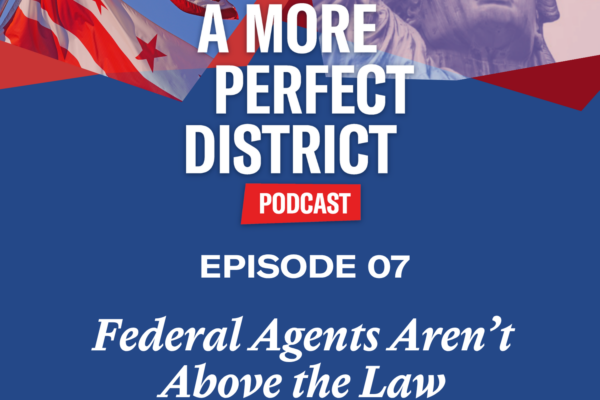
A More Perfect District - Episode 7 -You Can’t Have Democracy Without D.C.

Federal Agents Aren’t Above the Law

No one should be above the law, including federal law enforcement. Yet when federal agents violate people’s constitutional rights, holding them accountable can be extraordinarily difficult. In this episode of A More Perfect District, ACLU-DC Paralegal & Intake Coordinator Ameerah Adetoro talks with Legal Director Scott Michelman about the barriers that can make it difficult to hold federal officers accountable, why accountability matters for protecting all of our rights, and what we can do to push for change.
Press Release
Placeholder image

Federal Court Rules Washington, D.C. Parole and Supervised Release System Discriminates Against People with Disabilities

In federal court victory, ACLU and allies secure ruling that D.C. parole system discriminates against people with disabilities
Press Release
Placeholder image

The ACLU and Affiliates Nationwide Underscore Urgent Need for National Guard to Leave the Nation’s Capital

In a letter addressed to the American public, ACLU and affiliates warn prolonged deployments carry nationwide costs and risk normalizing military presence on American streets
Press Release
Placeholder image

Decorated Veteran Assaulted by National Guard Troops in D.C. Files Legal Claim to Challenge Abuse

Filed by the ACLU of D.C. and law firm Levy Firestone and Muse, LLP, this claim is one of 54 filed by the ACLU and its affiliates across 17 states under the Federal Tort Claims Act that seek justice for people harmed by federal agents

Cases, Campaigns & Legislation


Court Case
Oct 2, 2026

Nielsen v. Watanabe – Fighting for the Right To Seek Redress for Constitutional Violations by Federal Prison Officers

Kekai Watanabe was brutally attacked in a prison fight and his tailbone was broken. For months, prison staff at the federal prison in Hawai‘i where he was detained denied his requests for hospital care, providing him instead with over-the-counter pain medication. Mr. Watanabe sued, seeking damages for his months of pain and suffering. Doing so is his only way to hold accountable the officials who ignored his repeated requests for care. But the government now argues that he has no right to sue a federal prison official. Although state and local officers who violate the Constitution in this same way could be sued for it, there’s no federal law specifically creating a right to sue federal officers for constitutional violations, and so the government argues such suits cannot proceed. Using this type of reasoning, the Supreme Court in recent years has made it extremely difficult to sue federal officers. This rule creates a major gap in constitutional enforcement, especially here in D.C., where there is a huge federal law enforcement presence. Because of the Supreme Court’s hostility toward claims against federal officers, for instance, our case seeking damages for the massive, unprovoked assault on peaceful civil rights demonstrators at Lafayette Square in the summer of 2020 is proceeding on very different terms against the federal officers than against the local officers involved in the same incident: whereas against the D.C. police we have been allowed to proceed as a class action and will be able to seek punitive damages, we could proceed only on behalf of a handful of individuals (not a class) for constitutional violations by the U.S. Park Police, Secret Service, and other federal defendants like former Attorney General William Barr, and we cannot seek punitive damages for the federal offers’ violations. Together with the National ACLU and the ACLU of Hawai‘i, we filed a friend-of-the-court brief in support of Mr. Watanabe at the Supreme Court. Even the Court’s restrictive recent decisions about suing federal officers acknowledge that Congress, in the Westfall Act of 1988, preserved the ability to bring some federal officer claims. When Congress legislates about a well-established legal concept, courts presume that Congress intended to incorporate that established meaning. At the time of the Westfall Act’s passage, courts permitted claims—like Mr. Watanabe’s—alleging unconstitutionally deficient prison medical care by federal officers. Therefore, to respect the instructions of Congress, the courts should continue to permit such claims today. A contrary result would be disastrous, and not just for Mr. Watanabe. One of the government’s main arguments here is that a federal-officer suit cannot proceed because federal prisons have an internal grievance process, known as the “ARP.” When appeals courts have applied this ahistorical limitation on what federal-officer suits are available, the results have been grotesque. For instance, the Eleventh Circuit recently relied on the ARP to reject a constitutional claim for fatally inadequate medical treatment of Hepatitis C in prison “even though [the plaintiff’s] estate could not use the ARP after his death.” Carrin v. Strong, 182 F.4th 1351, 1354 (11th Cir. 2026). The Third Circuit relied on the ARP to reject a constitutional claim for the failure to treat diabetic blisters that ultimately required the amputation of the plaintiff’s toe, even though the “effectiveness” of the ARP was “dubious.” Muniz v. United States, 149 F.4th 256, 258, 264 (3d Cir. 2025). And the Eleventh Circuit relied on the ARP in rejecting a constitutional claim for failure to treat an incarcerated plaintiff’s “severe but ultimately non-lethal physical injuries” even though “the district court found that he was denied access to the [ARP].” Johnson v. Terry, 119 F.4th 840, 858-60 (11th Cir. 2024). These outcomes are both unfair and contrary to what Congress directed when it acted in 1988. The Supreme Court will hear argument in this case November 9.
Court Case
Jul 29, 2026

King v. United States – Challenging National Guard Members’ Violent Seizure of a Veteran

Anna King is a retired U.S. Army captain and an Iraq War veteran, receiving a Purple Heart and a Bronze Star for her service. On May 8, 2026, she was at her home when three National Guard members walked through her gated patio and seized her, shoving her toward the ground, grabbing her arms, and applying handcuffs so tightly that they ruptured ligaments in her wrist, requiring surgery. It appears the officers who arrived at Ms. King’s home did not have a warrant for Ms. King’s arrest. In conjunction with the law firm Levy Firestone Muse LLP, we filed an administrative Federal Tort Claims Act complaint with the Idaho National Guard (which employs several of the Guard members involved) and the Department of Defense to vindicate King’s rights.
Court Case
Mar 10, 2025

Kingdom v. Trump – Challenging Denial of Gender Affirming Care to Incarcerated People with Gender Dysphoria

This case concerns a ban on life-saving medical treatment for incarcerated people with gender dysphoria. Gender dysphoria arises when someone experiences clinically significant distress based on an incongruence between their gender identity (that is, their internal sense of gender) and sex designated at birth. Everyone has a gender identity; however, for some people, it does align with their sex assigned at birth. That, in and of itself, is not a health disorder. Gender dysphoria arises when people experience clinically significant distress from the incongruence. If untreated, gender dysphoria can result in severe anxiety and depression, self-harm, and suicidality. The widely approved treatment for gender dysphoria resolves the distress by enabling individuals to live consistently with their gender identity. That can involve social transition (such as using a name, pronoun, and clothing associated with one’s gender identity), hormone treatment to masculinize or feminize the body, and surgeries to change certain sex characteristics. During the first Trump administration, and the Biden administration, the Federal Bureau of Prisons (BOP) provided gender affirming care to incarcerated people with gender dysphoria when a doctor concluded doing so was appropriate. On January 20, 2025, President Trump issued an Executive Order titled “Defending Women from Gender Ideology Extremism and Restoring Biological Truth to the Federal Government.” The order bans BOP from using federal funds for “any medical procedure, treatment, or drug for the purpose of conforming an inmate’s appearance to that of the opposite sex.” BOP responded to the order by banning incarcerated transgender people from obtaining accommodations (such as gender-appropriate undergarments) and terminating (or threatening to terminate) their hormone treatments. BOP restored at least some individuals’ hormone treatment, but only after this lawsuit was filed and a court intervened in a related case. Plaintiffs Alishea Kingdom, Solo Nichols, and Jas Kapule—all incarcerated transgender individuals with gender dysphoria—bring this case on behalf of themselves and others similarly situated in order to protect their basic right to crucial medical care and equal treatment under the law.
Court Case
Mar 18, 2025

Martin v. United States – fighting to preserve federal officer accountability for constitutional violations

Curtrina Martin and her partner were injured and terrorized during a violent pre-dawn FBI raid on their suburban Atlanta home in 2017, all because the FBI agents went to the wrong address. Fifty years ago, in response to similar wrong-house raids, Congress enacted the “law-enforcement proviso” in the Federal Tort Claims Act (“FTCA”). That provision, which enables people to sue the government for “assault, battery, false imprisonment, false arrest, abuse of process, or malicious prosecution” by “investigative or law enforcement officers of the United States Government,” ensures that people like Ms. Martin have can go to court to seek a remedy for the harms the government inflicted on them. After the trial and appellate courts held that Ms. Martin’s case could not proceed, the Supreme Court agreed to review it to consider the proper reading of the “law-enforcement proviso,” which is a critical tool for holding the federal government accountable when federal officers injure people through unconstitutional physical force or arrests. Together with the National ACLU, the ACLU of Georgia, Public Accountability, and the Cato Institute, we filed an amicus brief to argue that “law-enforcement proviso” claims cannot be defeated by the government’s argument that officials were acting in an area in which they had “discretion.” We explain why the government’s argument fails both as a matter of statutory interpretation and because the government never has “discretion” to commit a constitutional violation. Further, we argue that the Court should not accept the government’s proposal to import into the FTCA a version of “qualified immunity” — the problematic rule (which we have opposed in a number of other cases) that officers’ actions cannot result in liability unless their actions were not just unconstitutional but in violation of “clearly established” law. This unnecessarily high barrier to holding officials accountable dilutes the force of constitutional rights and has no basis in text, history, or policy.