Due Process/Procedural Rights

The Fifth and Fourteenth Amendments protect everyone’s right to due process of law. This right is foundational; when the government denies fair treatment to particular individuals or operates with unfair procedures, it makes it impossible to enforce the other rights guaranteed by the Constitution. The ACLU works to protect our rights to due process everywhere in settings as varied as the local courts, federal workplaces, schools, and Guantanamo and Afghanistan.
Due Process

The Fifth and Fourteenth Amendments protect everyone’s right to due process of law. This right is foundational; when the government denies fair treatment to particular individuals or operates with unfair procedures, it makes it impossible to enforce the other rights guaranteed by the Constitution. The ACLU works to protect our rights to due process everywhere in settings as varied as the local courts, federal workplaces, schools, and Guantanamo and Afghanistan.

The Latest
News & Commentary
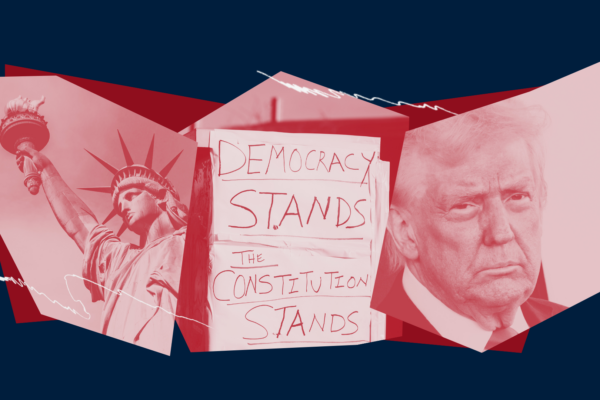
A stylized graphic with a dark blue background featuring three overlapping red-tinted panels. The left panel shows the Statue of Liberty holding a torch. The center panel displays a handwritten sign that reads “DEMOCRACY STANDS” and “THE CONSTITUTION STANDS.” The right panel includes an image of Donald Trump.

A Year of Resistance in the Nation’s Capital: How D.C. Resisted the First Year of the Second Trump Administration

2025 has brought one emergency after another. But in this crisis, residents across D.C. fought for their rights and showed why the urgency of self-governance in D.C. is more important than ever.
Press Release
Placeholder image

Community Members and Immigrants’ Rights Organizations Take Trump Administration to Court to Stop Illegal Arrests of Immigrants

Four Washington, D.C. community members and the national immigration organization CASA sued the Trump administration today on behalf of themselves and a class of similarly-situated individuals, alleging that the federal government has engaged in a pattern of illegal immigration arrests since August.
Press Release
Placeholder image

Federal Court Blocks Trump Administration Fast-Track Deportation Policy

This ruling is a vital reminder that due process is not optional. Expanding expedited removal would have exposed thousands to potential wrongful deportation, without even the chance to make their case.
Press Release
Placeholder image

St. Elizabeths Hospital Settles Case with Patients Who Endured Life Threatening Conditions During Water Crisis and COVID-19

“This settlement will help ensure that the government meets its constitutional obligation to provide a safe environment for the patients of St. Elizabeths.”
Court Case
Jan 15, 2026

New York Times v. Department of Defense - Opposing Government Control Over Pentagon Journalists' Reporting

Once again, the Trump Administration is attempting to exert unconstitutional control over the content of expression—this time, by affording executive officials unbridled discretion to revoke Pentagon correspondents’ press access for receiving, soliciting, or reporting “unauthorized” information. In the fall of 2025, the Department of Defense promulgated a new policy granting Pentagon officials unbridled and standardless discretion to deem a journalist “a security or safety risk to [Department] personnel or property,” including on the basis of that journalist’s (or their news organization’s) receipt, publication, or “solicitation” of any information, classified or unclassified, that is not “authorized” by the Department. Under the Policy, such conduct—which is the bread and butter of independent journalism—is punishable by suspension of journalists' Pentagon access. Rather than subject themselves to these viewpoint-based restraints on their reporting and the limitless discretion of Administration officials to kick them out, New York Times reporters turned in their press credentials and sued, asserting violations of the First Amendment and due process. Thereafter, the new "Pentagon press corps" consisted of ideological allies of the Trump Administration. In January 2026, we and the National ACLU filed an amicus brief in support of the New York Times' motion for summary judgment. Our brief placed the Pentagon policy in historical and global context. We argued that American history shows that scrupulous protection of the press’s right to disseminate information, without fear or favor to those in power, is essential to our democracy. From early American history, to World War I, to the Second Red Scare, our country has regretted the moments it has faltered in protecting the free press. And we argued that developments in other democracies and former democracies highlight the dangers of allowing the government to infringe on speech and press freedoms. Across the world—including in the Philippines, Hungary, Turkey, and Russia—democracies have backslid into repressive regimes with few freedoms after their institutions failed to hold the line on free expression. The lessons from history and other nations' experience should strengthen courts' resolve to apply the First Amendment rigorously, especially when the Trump Administration is relentlessly pursuing ideological conformity by attempting to punish or silence disfavored speech by lawyers, students, government employees, and universities, as well as journalists and media outlets.
Court Case
Nov 12, 2025

Federal Education Association v. Trump – Protecting the Rule of Law and Separation of Powers by Urging the D.C. Circuit to Apply the Correct Standard for Claims That the Government is Acting Without Legal Authority

On March 27, 2025, President Trump issued an Executive Order excluding the Federal Education Association and other unions representing educators who work in schools operated by the Department of Defense Education Activity (collectively, “Plaintiffs”) from coverage under the Federal Service Labor-Management Relations Statute (“FSLMRS”), which protects federal employees’ collective bargaining rights. The plaintiff unions sued and moved for a preliminary injunction, arguing that the Executive Order violates the First and Fifth Amendments and is ultra vires (in excess of) the President’s authority under the FSLMRS. The district court granted Plaintiffs’ motion for a preliminary injunction, holding that they established a likelihood of success on the merits of their ultra vires claim. The government appealed the district court’s decision to the U.S. Court of Appeals for the D.C. Circuit. It contends that Plaintiffs are unlikely to succeed for three reasons: first, that the district court lacked jurisdiction because the FSLMRS requires Plaintiffs to submit their claims to the Federal Labor Relations Authority (“FLRA”); second, that the district court lacked jurisdiction over Plaintiffs’ ultra vires claim because the FSLMRS commits exclusion decisions to the President’s unreviewable discretion; and third, that even if Plaintiffs’ ultra vires claim were reviewable, Plaintiffs would face a demanding standard—a “Hail Mary pass”—to win on their claim. Specifically, the government argues that to prevail on their ultra vires claim, Plaintiffs must show that the President’s decision to exclude Plaintiffs from the statute’s coverage was contrary to a specific prohibition in a statute, rather than simply that the President’s action was unauthorized by the statute. On November 12, 2025, we filed an amicus brief in support of Plaintiffs to refute the government’s argument that such a demanding standard applies categorically. We argue that the standard that the government proposes is a narrow exception to the default standard for ultra vires claims. Under the default standard, a plaintiff bringing an ultra vires claim is not required to show that a government official’s action was contrary to a specific prohibition in a statute. Instead, the plaintiff only needs to show that the official’s action was unauthorized by law. This default standard is over a century old and well-established in the Supreme Court’s precedents and supported by the D.C. Circuit’s precedents. By contrast, the demanding standard the government proposes for ultra vires claims should apply only where Congress has limited judicial review. The standard courts apply to ultra vires claims is important because it can determine whether the party challenging unlawful executive action will win or lose its claim. Under the government’s position, any time a party alleges that a government official is acting without legal authority and there is no private right of action in a statute, the party would need to satisfy the heightened “Hail Mary” standard, making it highly unlikely it will win. Such a rule would undermine rule of law and separation of powers principles and improperly hamper courts’ ability to review executive action for compliance with federal law. We therefore urged the D.C. Circuit in our amicus brief to apply the ordinary, default standard to Plaintiffs’ ultra vires claim if the FSLMRS does not limit judicial review of the President’s exclusion decision. The D.C. Circuit is scheduled to hear oral argument in this case on December 15, 2025.
Court Case
Oct 29, 2025

Trump v. Cook – Protecting the Rule of Law and Separation of Powers by Urging the Supreme Court to Apply the Correct Standard for Claims that the Government is Acting Without Legal Authority

In August 2025, President Trump removed Governor Lisa Cook from the Federal Reserve’s Board of Governors based on his determination that he had cause to do so. Governor Cook sued, arguing that the President’s decision to remove her violated her due process rights and was ultra vires (in excess of) the authority Congress granted the President because it was not “for cause” as required by the Federal Reserve Act. After the lower courts granted Governor Cook’s request for an injunction to prevent her removal, the government filed an application in the Supreme Court to stay (pause) the injunction. The government made two arguments in its stay application in response to Governor Cook’s ultra vires claim: first, that President Trump’s decision to remove Governor Cook is unreviewable in court because the determination of cause is committed to the President’s unreviewable discretion, and second, that even if a court could review President Trump’s decision, Governor Cook would face a demanding standard—a “Hail Mary pass”—to win on her claim. Specifically, the government argued that to prevail on her ultra vires claim, Governor Cook would need to show that that the President’s action was contrary to a specific prohibition in a statute, rather than simply that the President’s action was unauthorized by the statute. Together with the National ACLU and The Rutherford Institute, we filed an amicus brief in support of neither party to refute the government’s argument that such a demanding standard applies. We argue that the standard that the government proposes is a narrow exception to the default standard for ultra vires claims. Under the default standard, a plaintiff bringing an ultra vires claim is not required to show that a government official’s action was contrary to a specific prohibition in a statute. Instead, the plaintiff only needs to show that the official’s action was unauthorized by law. This default standard is over a century old and well-established in the Supreme Court’s precedents. By contrast, the demanding standard the government proposes for ultra vires claims should apply only where Congress has limited judicial review. The standard courts apply to ultra vires claims is important because it can determine whether the party challenging unlawful executive action will win or lose its claim. Under the government’s position, any time a party alleges that a government official is acting without legal authority and there is no private right of action in a statute, the party would need to satisfy the heightened “Hail Mary” standard, making it highly unlikely it will win. Such a rule would undermine rule of law and separation of powers principles and improperly hamper courts’ ability to review executive action for compliance with federal law. We therefore urged the Supreme Court in our amicus brief to apply the heightened standard the government proposes to Governor Cook’s ultra vires claim only if the Federal Reserve Act limits judicial review. The Supreme Court is expected to hear oral argument in this case in January 2026.
Court Case
Oct 22, 2025

Quiñonez v. United States - Seeking To Expand Federal Officer Accountability for Constitutional Violations

Rene Quiñonez owns a small print shop in Oakland, California. In 2020, at the height of the pandemic and the summer of civil rights activism following the murder of George Floyd, he received his biggest order ever, for thousands of cloth masks printed with protest slogans (like "Stop Killing Black People"). But a postal clerk seized the shipment, harming Mr. Quiñonez's business. Mr. Quiñonez sued, alleging that the clerk had no legitimate reason to seize the masks and violated his constitutional rights in doing so. The district court threw the case out, ruling that Mr. Quiñonez had not met the strict standards for suing federal officers. This case implicates a problem bigger than one shipment of masks: whether people whose rights are violated by federal officers can sue to obtain redress. State and local officers who violate the Constitution could be sued for it, because there's a specific federal law saying so. Because Congress didn't pass a similar law for federal officers, the Supreme Court has made it extremely difficult to sue federal officers — regardless of the merits of the case. So even if the Constitution was clearly violated, if the wrongdoer was a fed, the victims usually cannot bring a constitutional claim against him. This rule creates a major gap in constitutional enforcement, especially here in D.C., where there is a huge federal law enforcement presence. Because of the Supreme Court's special hostility toward claims against federal officers, for instance, our case seeking damages for the massive, unprovoked assault on peaceful civil rights demonstrators at Lafayette Square in the summer of 2020 is proceeding on very different terms against the federal officers than against the local officers involved in the same incident: whereas we were able to certify a class action and will be able to seek punitive damages against the D.C. police, we could proceed only on behalf of a handful of individuals (not a class) against the U.S. Park Police, Secret Service, and other federal defendants like former Attorney General William Barr, and we cannot seek punitive damages. Mr. Quiñonez appealed the dismissal of his case. Together with the ACLU of Northern California, we filed an amicus brief supporting Mr. Quiñonez's appeal, on the issue of federal officer accountability. We explained how, separate from the path to accountability that the Supreme Court has shut off under federal law, state and local laws still permit suits against federal officers for constitutional violations. Rights without remedies are not worth very much. It is our goal to establish a clear path by which federal officers can be held accountable for violations of constitutional rights.