Court Cases
Featured Cases
Oct 23, 2025
O’Hara v. Beck – Defending the Right To Protest the National Guard
In Star Wars, the Imperial March is the music that plays when Darth Vader and his storm troopers enter the scene. It’s also the soundtrack of Sam O’Hara’s protest against the National Guard’s presence in D.C.
National Guard troops arrived in the District after President Donald Trump deployed them to support local police—an act that Mr. O’Hara views as a violation of centuries-old norms against militarizing domestic law enforcement and a threat to individual freedom.
To highlight the surreal danger of the deployment, Mr. O’Hara began walking behind Guard members when he saw them in the community, playing The Imperial March on his phone, and recording. Most community members got the point of the protest, and so did several members of the Guard, who either smiled or laughed in response.
Ohio National Guard Sgt. Devon Beck, however, was not amused by the satire. He threatened to call MPD if Mr. O’Hara didn’t stop his protest. When Mr. O’Hara persisted, Sgt. Beck recruited MPD officers to the scene, and the officers proceeded to detain and handcuff Mr. O’Hara, ending his demonstration.
The First and Fourth Amendments (not to mention D.C. law) bar government officials from detaining people just because of their speech. Mr. O’Hara is suing to vindicate that principle.
Press Release
Jan 12, 2026
Fell v. Trump (formerly Stainnak v. Trump) - Challenging Purge of DEI-Associated Federal Workers As Discriminatory and Retaliatory for Perceived Political Beliefs
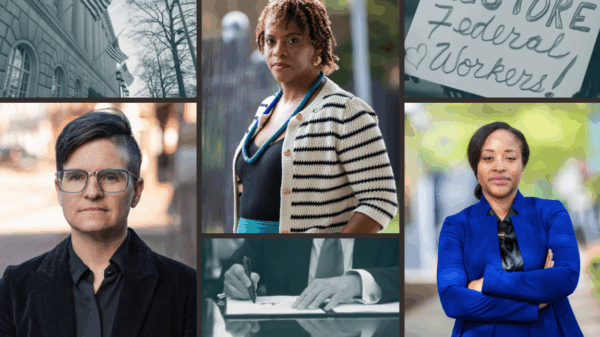
Federal employees filed a complaint against the Trump administration for targeting workers, especially people of color, women, and non-binary workers, for participating in diversity, equity, and inclusion (DEI) activities, violating their First Amendment rights.
All Cases
78 Court Cases
May 04, 2026
Doe v. Mullin – Challenging DHS’s Use of Administrative Summonses to Unmask Social Media Critics
The Department of Homeland Security has ordered multiple Internet Service Providers and social media companies to disclose sensitive information about users who criticized DHS’s practices. DHS has issued these demands through administrative summonses or subpoenas, which require approval only by DHS itself and not a neutral judge.
This case challenges another instance of this disturbing trend. Plaintiff John Doe regularly criticizes President Trump and DHS on X and other social media platforms, with his posts collectively receiving well over 100,000 views. Now, DHS wants to obtain detailed information about Mr. Doe and his activities. The government sent an administrative summons to Google, ordering it to disclose “[a]ll records and other information” it possesses relating to the Gmail account Mr. Doe linked to his X account. DHS’s demand expressly includes Mr. Doe’s name, his location information, and data on his online activity—records that could allow the government to trace Mr. Doe’s physical movements and discern the things he reads online and the people with whom he communicates there.
Court cases challenging similar summonses have involved the U.S. government targeting people inside the U.S. This case represents a potentially new and troubling development, as Mr. Doe is a Canadian citizen and resident. If DHS can surveil him, it may be able to monitor any critic anywhere on the globe.
DHS’s actions in this case are unlawful. The government can act only based on authority conveyed via the Constitution or a statute and here, the statute DHS invoked provides no basis to issue the summons. Represented by the ACLU-DC and the ACLU of Northern California, Mr. Doe brings this case to stand up to DHS’s blatant abuse of government power.
Apr 23, 2026
Accountability NOW USA v. Griess, et al. – Defending the Right to Display Signs Accusing President Trump of Sex Crimes
Accountability NOW is a group of volunteers who have been holding a permitted, 24/7 anti-Trump vigil on National Park Service (NPS) land in Washington, D.C., for months. After they erected signs saying "Trump raped little girls,” and “Kids, if your parents are MAGA, they love child rapists,” NPS demanded they remove the signs because they are “obscene,” and therefore, not protected by the First Amendment. But the signs are not obscene.
Legal obscenity is an extremely narrow exception to the First Amendment’s protection and does not apply to signs like these. For example, the media has extensively covered Jeffrey Epstein’s crimes on TV and online, but those reports do not satisfy the legal test for obscenity, which is designed to capture things like hardcore pornography that have no artistic or other value. This case shows why the test is so strict: If politicians could stop you from accusing them of sexual misconduct by saying that the accusation is obscene, they could avoid accountability. That’s what the First Amendment prevents.
We are asking the court to prohibit NPS from revoking its demonstration permit on this trumped-up ground. We hope that this lawsuit will remind government officials to take Americans’ First Amendment rights seriously.
Apr 04, 2026
National Public Radio v. Trump & Public Broadcasting System v. Trump – Opposing Defunding of Public Broadcasting
On May 1, 2025, President Trump issued an executive order titled “Ending Taxpayer Subsidization of Biased Media,” which directs the Corporation for Public Broadcasting and federal agencies to terminate all direct and indirect funding to NPR and PBS in explicit retaliation for the broadcasting organizations’ editorial and journalistic choices, which the order characterizes as “biased” and “partisan.”
NPR and PBS each filed lawsuits challenging the executive order. On June 20, we ACLU filed amicus briefs in both cases (together with the National ACLU and the ACLUs of Colorado and Minnesota, where some plaintiffs in the cases are located), supporting the NPR and PBS motions for summary judgment, and arguing that the executive order constitutes a flagrant violation of the First Amendment because it retaliates against both speakers solely for their constitutionally protected speech, including the words they choose to use in coverage and what stories they choose to highlight. The briefs also argue that the order unconstitutionally restricts federal funding, including funds appropriated for local public broadcasters throughout the country to use as they see fit, based on President Trump’s disapproval of NPR’s and PBS’ news coverage. The briefs warn that the executive order threatens the editorial independence of local public broadcasters nationwide, undermines the congressionally mandated purpose of the Public Broadcasting Act, and endangers essential infrastructure like the Public Radio Satellite System, which reaches 99 percent of the U.S. population and plays a critical role in national emergency communications.
On March 31, 2026, Judge Randolph D. Moss ruled in favor of NPR and PBS. He explained:
“The President may, of course, engage in his own expressive conduct, including criticizing the views, reporting, or programming of NPR, PBS, or any other news outlet with whom he disagrees. The government may also fund its own speech and may fund government programs that promote specific perspectives on issues of public importance, and it may decide which views or perspectives to convey—and which not to convey—in any such government speech or program. And it may impose limits on federal grants to ensure that they are deployed to further the legitimate purposes of the program and may pick and choose among applicants based on legitimate criteria. But the First Amendment draws a line, which the government may not cross, at efforts to use government power—including the power of the purse—“to punish or suppress disfavored expression” by others. … As the Supreme Court and D.C. Circuit have observed on more than a dozen occasions, the government “may not deny a benefit to a person on a basis that infringes his constitutionally protected . . . freedom of speech even if he has no entitlement to that benefit.” … Executive Order 14290 crosses that line.”
He issued a permanent injunction prohibiting the Trump administration “from implementing or enforcing Executive Order 14290’s instruction to cease funding NPR and PBS.”
As a practical matter, the injunction will not restore all government funding to NPR and PBS, because Congress has defunded the Corporation for Public Broadcasting, which provided a great deal of financial support. Some support comes from other agencies, however, such as the National Endowment for the Arts, the Department of Education, and even FEMA. Those agencies can no longer withhold funds pursuant to the Executive Order.
Mar 27, 2026
Zaid v. Executive Office of the President – Challenging Revocation of Security Clearance for Retaliatory Political Reasons
In March 2025, President Trump issued an order directing “every executive department and agency head . . . to revoke any active security clearances held by” a group of named individuals “and to immediately rescind their access to classified information.” That list included Hillary Clinton, Kamala Harris, Elizabeth Cheney, former Secretary of State Antony Blinken, New York Attorney General Letitia James, former President Joseph Biden, “and any other member of Joseph R. Biden Jr.’s family.” That list also included Mark Zaid, an attorney who represents national security whistleblowers and other clients in cases involving classified information—significantly including the intelligence community whistleblower whose disclosures resulted in President Trump’s first impeachment. President Trump has called Mr. Zaid a “sleazeball,” and has said “he should be sued and maybe for treason.”
Mr. Zaid sued, and in December 2025 won a preliminary injunction restoring his clearance. The government appealed, and on March 27, 2026, we filed an amicus brief supporting him, together with the National ACLU, the Knight First Amendment Institute at Columbia University, the Electronic Frontier Foundation, and the Rutherford Institute.
Argument is scheduled for May 14, 2026.
Feb 23, 2026
Media Matters for America v. Federal Trade Commission – Protecting the Media from Sham Investigations
In February 2026, we joined with the Foundation for Individual Rights and Expression and the National ACLU to file an amicus brief in this First Amendment case, supporting Media Matters for America.
Media Matters for America is a research and journalistic nonprofit dedicated to monitoring and correcting misinformation in U.S. media. After Elon Musk purchased Twitter and renamed it X, Media Matters published articles reporting on increased “extremist and racist rhetoric” on X and about how advertisements for major companies were appearing adjacent to “pro-Nazi content.” Mr. Musk took offense and promised “a thermonuclear lawsuit against Media Matters.”
X Corp. made good on Musk’s threat, suing Media Matters in Texas federal court and (through subsidiaries) in Ireland and Singapore. A California federal court preliminarily enjoined X Corp.’s lawsuit campaign, recognizing that it appeared designed more to bully Media Matters and inflict financial hardship than to pursue legitimate claims.
Meanwhile, President Trump’s senior advisor Stephen Miller urged state attorneys general to focus on Media Matters, and the Texas and Missouri attorneys general answered his call and launched civil investigations, making onerous demands of Media Matters. Federal courts here in D.C. preliminarily enjoined both investigations on the ground that they likely amounted to First Amendment retaliation.
Piling on, the new Trump-appointed Chairman of the Federal Trade Commission, Andrew Ferguson, announced that the FTC would investigate purported “tech [platform] censorship” and “advertiser boycotts.” In numerous public statements, he and others made clear that the investigation was partisan and retributive, aimed at “progressives” and “leftists” who were allegedly seeking to “silence conservative voices.” The FTC issued a broad Civil Investigative Demand to Media Matters in May 2025 demanding information on a wide variety of expressive matters, including information about newsgathering and editorial decisions, programs. policies and objectives, financial material, and much more.
Media Matters sued again, initiating this lawsuit, and again obtained a preliminary injunction. In a thorough opinion, Judge Sparkle Sooknanan concluded, “[t]his case presents a straightforward First Amendment violation.”
The FTC appealed and is asking the court of appeals to allow it to continue its “investigation.” Our amicus brief shows how government investigations can be used to intimidate media outlets through procedural burdens and threats that themselves punish exercises of First Amendment rights. Allowing the FTC to pursue its investigation during the pendency of this case would continue to chill speech and journalism.
Our brief also points out that this case is not an outlier. The FTC itself is currently using the same playbook in a series of burdensome “investigations” of advertising agencies and news rating organizations to censor speech the Commission doesn’t like. And government officials nationwide increasingly use burdensome investigations to target publications, platforms, and others for their views. The courts should be vigilant to protect legitimate media from such sham investigations.
Jan 16, 2026
WALLBUILDERS V. WMATA – CHALLENGING METRO POLICY OF BANNING CONTROVERSIAL ADVERTISEMENTS
In this case, we argue that WMATA’s advertising guidelines violate the First Amendment, which prohibits government agencies from discriminating against private speech based on its viewpoint or from applying rules that so vague they can’t be applied consistently.
Jan 15, 2026
New York Times v. Department of Defense - Opposing Government Control Over Pentagon Journalists' Reporting
Once again, the Trump Administration is attempting to exert unconstitutional control over the content of expression—this time, by affording executive officials unbridled discretion to revoke Pentagon correspondents’ press access for receiving, soliciting, or reporting “unauthorized” information.
In the fall of 2025, the Department of Defense promulgated a new policy granting Pentagon officials unbridled and standardless discretion to deem a journalist “a security or safety risk to [Department] personnel or property,” including on the basis of that journalist’s (or their news organization’s) receipt, publication, or “solicitation” of any information, classified or unclassified, that is not “authorized” by the Department. Under the Policy, such conduct—which is the bread and butter of independent journalism—is punishable by suspension of journalists' Pentagon access.
Rather than subject themselves to these viewpoint-based restraints on their reporting and the limitless discretion of Administration officials to kick them out, New York Times reporters turned in their press credentials and sued, asserting violations of the First Amendment and due process. Thereafter, the new "Pentagon press corps" consisted of ideological allies of the Trump Administration.
In January 2026, we and the National ACLU filed an amicus brief in support of the New York Times' motion for summary judgment. Our brief placed the Pentagon policy in historical and global context. We argued that American history shows that scrupulous protection of the press’s right to disseminate information, without fear or favor to those in power, is essential to our democracy. From early American history, to World War I, to the Second Red Scare, our country has regretted the moments it has faltered in protecting the free press. And we argued that developments in other democracies and former democracies highlight the dangers of allowing the government to infringe on speech and press freedoms. Across the world—including in the Philippines, Hungary, Turkey, and Russia—democracies have backslid into repressive regimes with few freedoms after their institutions failed to hold the line on free expression.
The lessons from history and other nations' experience should strengthen courts' resolve to apply the First Amendment rigorously, especially when the Trump Administration is relentlessly pursuing ideological conformity by attempting to punish or silence disfavored speech by lawyers, students, government employees, and universities, as well as journalists and media outlets.
On March 20, 2026, the court ruled for the Times and held that the Pentagon's new rules violated both due process and the First Amendment, because the policy did not "provide fair notice of what routine, lawful journalistic practices will result in the denial, suspension, or revocation" of a press credential, and because the policy discriminated against journalists based on their viewpoint, "that is, whether the individual or organization is willing to publish only stories that are favorable to or spoon-fed by Department leadership." The court's opinion began: "A primary purpose of the First Amendment is to enable the press to publish what it will and the public to read what it chooses, free of any official proscription. Those who drafted the First Amendment believed that the nation’s security requires a free press and an informed people and that such security is endangered by governmental suppression of political speech. That principle has preserved the nation’s security for almost 250 years. It must not be abandoned now." Accordingly, the court enjoined the Pentagon's new rules.
In response, the Pentagon promulgated a new policy that further closed off Pentagon access and used new language to restore a regime similar to the enjoined policy. On April 9, the court ordered the government to halt the new policy as well, explaining that it would not "permit such a blatant attempt to circumvent a lawful order of the Court to succeed."
On April 10, the government appealed both orders to the D.C. Circuit.
Nov 13, 2025
Banks v. Hoffman - Advocating for Robust Protection Against Lawsuits Used to Chill Speech
A Strategic Lawsuit Against Public Participation (“SLAPP”) is a term for a legal action that is of little merit but is filed anyway for the purpose of stopping someone from engaging in (usually constitutionally protected) speech by burdening them with a costs of a lawsuit. In December of 2010, the D.C. Council passed, with our support, an Anti-SLAPP Act that provides a special procedure for people engaged in advocacy on public interest issues to have a court dismiss SLAPP suits quickly.
One of the provisions of the Anti-SLAPP Act limits the discovery (that is, court-ordered exchange of information among the parties in a lawsuit) that can occur when the Anti-SLAPP Act’s protections are invoked. This is because discovery can be costly and time-consuming, so that even speakers who should obtain dismissal of a SLAPP might be chilled from speaking in the first place if they knew they could be forced to undergo discovery before dismissal.
In this case, the D.C. Court of Appeals ruled that the discovery limitations of the Anti-SLAPP Act were invalid because they modified D.C. court procedures in a manner inconsistent with the D.C. Home Rule Act of 1973, by which Congress granted the District limited powers of self-government.
Together with many other public interest groups, we filed an amicus brief in support of reconsidering this decision, in the hope that the court will restore the discovery protections for speakers hit with SLAPPs.
For more information on Washington D.C.’s Anti-SLAPP Act, click on the following link: http://www.anti-slapp.org/your-states-free-speech-protection/
In January 2024, the court granted the petition for rehearing. In April 2024, we joined with other public interest groups once again to file an amicus brief on the merits discussing the importance of the Anti-SLAPP Act and its protections for public advocacy.
In November 2025, the en banc court unanimously upheld the Anti-SLAPP Act as consistent with the Home Rule Act, clearing the way for the Anti-SLAPP Act to play its intended role in protecting free speech.
Oct 22, 2025
Quiñonez v. United States - Seeking To Expand Federal Officer Accountability for Constitutional Violations
Rene Quiñonez owns a small print shop in Oakland, California. In 2020, at the height of the pandemic and the summer of civil rights activism following the murder of George Floyd, he received his biggest order ever, for thousands of cloth masks printed with protest slogans (like "Stop Killing Black People"). But a postal clerk seized the shipment, harming Mr. Quiñonez's business. Mr. Quiñonez sued, alleging that the clerk had no legitimate reason to seize the masks and violated his constitutional rights in doing so. The district court threw the case out, ruling that Mr. Quiñonez had not met the strict standards for suing federal officers.
This case implicates a problem bigger than one shipment of masks: whether people whose rights are violated by federal officers can sue to obtain redress. State and local officers who violate the Constitution could be sued for it, because there's a specific federal law saying so. Because Congress didn't pass a similar law for federal officers, the Supreme Court has made it extremely difficult to sue federal officers — regardless of the merits of the case. So even if the Constitution was clearly violated, if the wrongdoer was a fed, the victims usually cannot bring a constitutional claim against him.
This rule creates a major gap in constitutional enforcement, especially here in D.C., where there is a huge federal law enforcement presence. Because of the Supreme Court's special hostility toward claims against federal officers, for instance, our case seeking damages for the massive, unprovoked assault on peaceful civil rights demonstrators at Lafayette Square in the summer of 2020 is proceeding on very different terms against the federal officers than against the local officers involved in the same incident: whereas we were able to certify a class action and will be able to seek punitive damages against the D.C. police, we could proceed only on behalf of a handful of individuals (not a class) against the U.S. Park Police, Secret Service, and other federal defendants like former Attorney General William Barr, and we cannot seek punitive damages.
Mr. Quiñonez appealed the dismissal of his case. Together with the ACLU of Northern California, we filed an amicus brief supporting Mr. Quiñonez's appeal, on the issue of federal officer accountability. We explained how, separate from the path to accountability that the Supreme Court has shut off under federal law, state and local laws still permit suits against federal officers for constitutional violations.
Rights without remedies are not worth very much. It is our goal to establish a clear path by which federal officers can be held accountable for violations of constitutional rights.
Stay Informed
Sign up to be the first to hear about how to take action.
By completing this form, I agree to receive occasional emails per the terms of the ACLU’s privacy statement.
By completing this form, I agree to receive occasional emails per the terms of the ACLU’s privacy statement.