Donald Trump sure has a problem with being criticized.
That’s not breaking news. And he’s not the first president to have his feathers ruffled by public pushback to his policies or behavior. However he feels, though, the president and other government officials cannot weaponize the narrow free speech exceptions for “obscenity” or a “true threat” to shut down their critics.
That was the lesson the administration learned this summer when the National Park Service tried to revoke a permit for an ongoing street protest that criticized the president and drew attention to sexual misconduct allegations against Trump.
Since December 2025, a group of volunteers called Accountability NOW USA has been holding a protest on Constitution Avenue in Washington, D.C. They are there 24 hours a day, seven days a week. The group believes that Trump should be impeached and removed from office. And they share that message with reminders of Trump’s alleged connections to Jeffrey Epstein, including with signs that say, “Trump raped little girls,” and “Kids, if your parents are MAGA, they love child rapists.”
In the spring, the National Park Service claimed that those signs constitute “obscenity” and warned the group that its permit could be revoked if it did not remove the signs.
Represented by ACLU-D.C., Accountability NOW filed a federal lawsuit against the National Park Service, arguing that the First Amendment protected the group’s right to display the messages. The administration was wildly misusing the “obscenity” exception to the First Amendment.
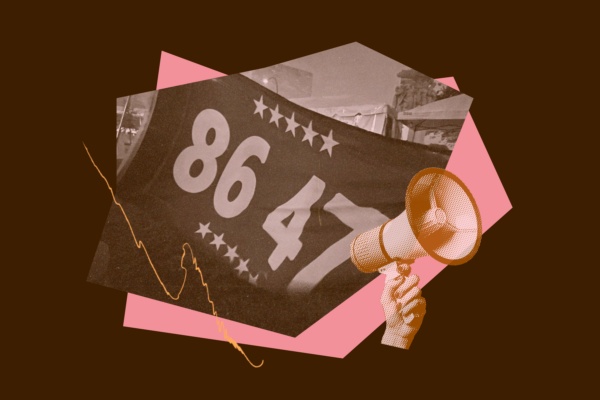
The day after we filed the lawsuit, at 5 a.m., the National Park Service again harassed the group, telling them that their sign saying “8647” was a threat to Trump and that their permit would be rescinded if they continued to fly it. The “8647” sign was an expression of Accountability NOW’s belief that Trump should be removed from office.
So we were back in court, asking a federal judge to stop the National Park Service from revoking the permit.
In late June, the court agreed with us. In what’s known as summary judgment (meaning that the court was deciding the case based on what had been filed, with no further proceedings), U.S. District Judge Randolph B. Moss found that the group’s speech is protected by the First Amendment and barred the National Park Service from rescinding the group’s permit. In his opinion, Judge Moss said:
Plaintiff’s signs accusing President Trump of raping a minor might outrage or offend some, but they do not, by any measure, cross the line from protected political speech to unprotected obscenity... Similarly, Plaintiff’s “8647” flag and similar materials... do not constitute a “true threat” or criminal “incitement” to violence. Rather, both sets of materials represent core protected speech.
So what is considered legally obscene? Legal obscenity is an extremely narrow exception to the First Amendment’s protection and does not apply to signs like these. The legal test for obscenity is designed to capture things like hardcore pornography that have no artistic or other value.
This case shows why the test is so strict: If politicians could stop you from accusing them of sexual misconduct by saying that the accusation is obscene, they could avoid accountability.
And what about the alleged “true threat” claim by the National Park Service? The context matters. Accountability NOW USA’s protest has always been about legally and peacefully removing Trump from office. Or, as one of the organization’s volunteers put it, she wants Trump “to live forever and rot in jail where he belongs.” The term “86” dates to the 1930s, when it meant that something was sold out. It later evolved to mean to get rid of something.
The court understood that context and recognized the organization’s expression as protected by the First Amendment.
The administration’s abuse of narrow exceptions to the First Amendment is exactly why free speech protection exists and why it’s so critical to defend. The bargain that elected and public officials accept when they take office is that they’re going to be criticized in public ways. It comes with the job. That freedom is foundational to our democratic system.
Fittingly, Accountability NOW USA stages its protest in the most sacrosanct space – the street. A public space, like streets, parks, and sidewalks, is characterized as a “traditional public forum.” There’s a long American tradition of critics of the government sharing their message on the street. The framers of the Bill of Rights understood that they had to enshrine that protection in writing.
The government does have some power to restrict speech in public spaces, such as requiring permits for large crowds or volume control or for maintaining the flow of motor vehicle or pedestrian traffic. But the government doesn’t get to pick and choose when it invokes those restrictions based on the content of the speaker’s message.
Accountability NOW USA has a point of view and the freedom to express it in public. The president doesn’t have to like it. But he and his administration do have to accept the organization’s right to say it.