
Like employees everywhere, federal workers learn many things on the job. Some are legitimately confidential; most (except at places like the CIA) are not. And government workers have a constitutional right—recognized by the Supreme Court—to share with the public information they learn on the job that is of public interest and not legitimately confidential. Indeed, the Court has recognized that government employees are “the members of a community most likely to have informed and definite opinions” about government policies and operations. “Accordingly, it is essential that they be able to speak out freely on such questions without fear of retaliatory dismissal.”
The Trump administration does not agree.
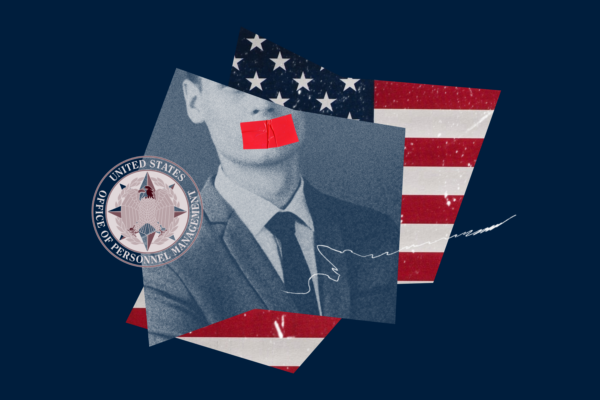
A rule being proposed by the Office of Personnel Management, if adopted by federal agencies, would require federal civil service workers to sign a nondisclosure agreement prohibiting them from talking without prior approval from their agency about a wide range of information they learn at work. In fact, the proposed rule is so vague and so broad that almost any job-related information a federal worker learns could be covered by the agreement. And while the administration claims signing the agreement is voluntary, if an agency adopts this NDA, refusal to sign could lead to being fired or denied a job.
For those who violate the NDA (based on the judgment of the employer), the consequences can include discipline, dismissal, and even criminal charges. Handing the government this power opens the door for it to selectively silence speech it doesn’t like.
The proposed NDA is a threat to both a functioning democracy and the federal workforce’s right to exercise first amendment rights. Going back to the Pentagon papers and Watergate, our recent history is filled with federal workers providing information to the public that informed the people of the United States about what their government was up to.
Recent history is the same. For example, earlier this summer, the Washington Post revealed that a new policy issued by the Interior Department prohibits the National Park Service from notifying the public about deaths in national parks. Current and former department employees told the Post that the past practice has been to publicly release information about deaths to provide guidance for keeping people safe in the parks.
The Post learned about the new policy from department employees. There was nothing legitimately secret about the new policy, but if those employees had been required to sign the proposed NDA, they would have violated it by talking to the Post.
Last year, NPR interviewed air traffic controllers, asking their opinions on problems at the nation’s airports, after a midair collision and several other near disasters. Had the proposed NDA policy been in place, the public could not have heard from these experts.
In 2024, Fox News reported information it received from intelligence officials about the Biden administration having suppressed information that could have suggested the COVID-19 virus may have originated in a lab. This, too, would be prohibited under the NDA.
These are just a few recent examples of how the ability of federal workers to speak about their jobs and what their agencies are doing leads to a better-informed public. That is vitally important for a functioning democracy and accountability for public officials. The proposed NDA is an unapologetic effort to prohibit such information seeing the light of day.
This is also more than a transparency issue. Federal workers’ ability to consult openly with their union representation could also be compromised, a point made by labor leaders in comments submitted to the Office of Personnel Management. Union members have to be able to speak with their union representatives when something happens in the workplace that requires union intervention. This NDA would undercut employees’ hard-earned labor protections.
At the heart of what’s wrong with the proposed NDA is its attack on federal workers’ right to free speech, which is protected by the First Amendment. Civil service employees don’t lose their constitutional rights when they accept a job with the government.
To be sure, the federal government has some leeway to restrict the speech of its workforce when acting as an employer. Some information is legitimately classified or deemed confidential. But those kinds of narrow exceptions are already covered by statutes and regulations. And the Supreme Court has protected the speech rights of federal workers on multiple occasions, holding that government employees have the right to speak on matters of public concern as long as their speech does not unduly interfere with the operation of the workplace—and that the right of the public to know what the government is doing also matters.
This proposed rule is currently in the public comment period. We hope that the Office of Personnel Management will heed our warning, and the multiple warnings of many other organizations that recognize that this NDA would violate the constitutional rights of federal employees and at the same time seriously interfere with the public’s right to know.
To read comments submitted by the ACLU and ACLU of D.C. about the proposed rule, visit this link.