Police Practices and Police Misconduct

Police officers have the vital and difficult job of protecting public safety – a job they must perform without trampling individuals’ civil liberties and civil rights. The ACLU works to ensure that police officers interact with the public on a race-neutral basis and with respect for individuals’ constitutional rights. Through policy advocacy and in court, we hold police officers and agencies accountable to the public that they serve.

Police

Police officers have the vital and difficult job of protecting public safety – a job they must perform without trampling individuals’ civil liberties and civil rights. The ACLU works to ensure that police officers interact with the public on a race-neutral basis and with respect for individuals’ constitutional rights. Through policy advocacy and in court, we hold police officers and agencies accountable to the public that they serve.

The Latest

Press Release
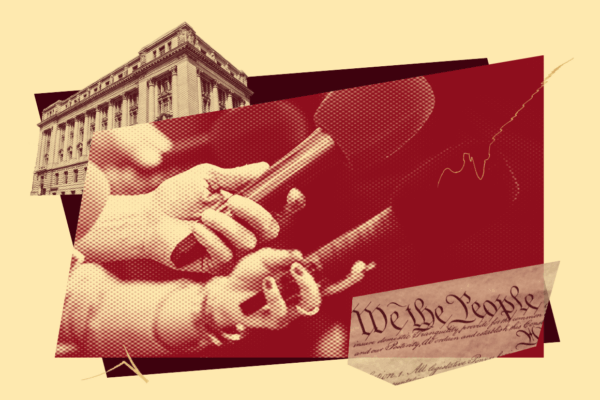
A collage featuring hands holding microphones, symbolizing media and press coverage. In the background, there is a large government building and a fragment of the U.S. Constitution with the words “We the People.” The design uses a red and beige color scheme with layered geometric shapes.

ACLU of D.C. Applauds District Council for Overriding Mayor’s Veto, Passing Federal Transparency Legislation

The Council of the District of Columbia today unanimously overrode a veto by Mayor Muriel Bowser, passing legislation to require the Metropolitan Police Department officers to document identifying information for all law enforcement officers present at the scene of an arrest.
News & Commentary
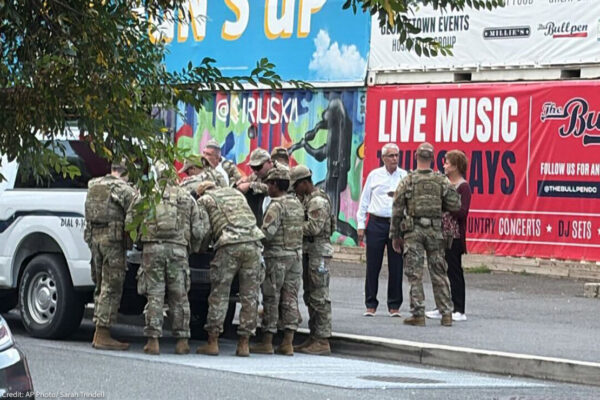
A group of uniformed soldiers gather around the back of a pickup truck on a city street, while a few civilians stand nearby. Behind them are colorful murals and a large sign advertising live music events.

Know Your Rights in Encounters with Law Enforcement and Military Troops

The recent militarization of D.C. is a reminder of how quickly government power can expand. Our guide explains what to do if you’re stopped by police or troops.
Know Your Rights
Stylized graphic of police officers in uniform wearing bulletproof vests, tinted red against a blue background. The design uses sharp geometric framing and halftone texture.

Encountering Law Enforcement and Military Troops in D.C.

No matter what uniform they wear, federal agents and military troops are bound by the Constitution, including our rights to peaceful assembly and due process.
Resource
Placeholder image

Home

Court Case
Apr 14, 2026

Carvajal-Muñoz v. Ravencamp – Seeking Accountability for Violent Abduction of Lawful Immigrant by Federal Agents

People in the United States have the right to go about their daily lives without being suddenly and violently abducted because of their skin color or ethnicity, or for no reason at all. This suit seeks to vindicate that right and to redress grave constitutional violations. Juan Sebastián Carvajal-Muñoz (“Sebastián”) moved to Maine from Colombia on a student visa to earn his master’s degree in civil engineering at the University of Maine. He then accepted a job as a civil engineer, specializing in conducting soil and foundation analyses for bridge construction across Maine. He was invited to stay in the United States under the H-1B visa program, which permits noncitizens to work legally in the U.S. if they can “perform services of exceptional merit and ability.” On the morning of January 22, 2026, during the federal government’s “Operation Catch of the Day” immigration crackdown in Maine, armed federal agents abducted Sebastián while he was driving to work. They cut in front of Sebastián’s car, bashed in his window, dragged him out of the car, handcuffed him, and left his car running in the middle of the street in downtown Portland. Sebastián offered proof of his lawful immigration status. Yet the agents told Sebastián that his visa would be revoked and placed him in full-body shackles. Agents then drove Sebastián around for hours, refused to release him despite instruction to do so, and instead locked him in a windowless cell in an ICE facility in Massachusetts. As abruptly as the agents had abducted him, they released him in Burlington, Massachusetts, after 9 p.m. that night, leaving him to find his way back home. The agents’ actions were unconstitutional for multiple reasons. First, federal agents stopped Sebastián without any reasonable suspicion that he was in the country unlawfully or had committed any other offense. Second, federal agents arrested him without a warrant and without probable cause to believe he was removable, ignoring proffered proof that he had lawful immigration status. Third, federal agents engaged in discrimination, arresting Sebastián for no reason other than his apparent race, skin color, or ethnicity. Fourth, federal agents used unreasonable force and violence against Sebastián, pointlessly breaking his car window, dragging him from his car, and placing him in full-body shackles. And fifth, independent of the unlawfulness of the seizure at its inception, the length of time agents kept Sebastián detained was likewise unreasonable and unconstitutional. The federal agents’ conduct violated the constitutional guarantees of equal protection and freedom from unreasonable search and seizure under the Fourth and Fifth Amendments. The federal agents’ conduct toward Sebastián is consistent with DHS’s broader campaign of conducting mass immigration arrests without a warrant or any lawful basis. DHS’s dragnet ensnares noncitizens based solely on their race, skin color or ethnicity, including individuals like Sebastián with lawful immigration status. These brutal stops and arrests terrorize immigrant communities and disrupt even the most ordinary of activities—working, going to school, shopping, driving. In addition to vindicating Sebastián's rights and compensating him for the physical and emotional harms he has suffered, this case is important to try to reestablish a critical path to holding federal officers accountable for constitutional violations. In 1971, the Supreme Court held that people could sue directly under the Constitution when federal officers violated their rights, but in 2017, the Supreme Court dramatically narrowed the ability of such cases to proceed—creating a huge and alarming accountability gap between federal and state officers. For example, after Minneapolis Police Officer Derek Chauvin murdered George Floyd in 2020, Mr. Floyd’s family sued the City of Minneapolis and police officers for violating his constitutional rights, ultimately securing a $27 million settlement. By contrast, following the recent Supreme Court's turn against federal-officer accountability, federal law does not allow the families of Alex Pretti and Renee Good to file that same type of lawsuit against the federal agents who shot and killed them just miles from where Mr. Floyd was murdered. Historically, people could use state law to sue federal officers for wrongdoing. We believe that state law could once again play that role, closing up the accountability gap that the Supreme Court has created. The Maine Civil Rights Act is one of the most promising state laws currently on the books that could do so, so we have invoked it in Sebastián's case. When federal agents face no consequences, that impunity invites more wrongdoing, turns our freedoms into empty promises, and leaves us all unprotected. U.S. courts have long recognized the fundamental legal principle that where there is a right, there must be a remedy. We hope this case will help make good on that promise and expand people's ability to seek justice when the federal government violates their constitutional rights.
Court Case
Oct 23, 2025

O’Hara v. Beck: Defending the Right To Protest the National Guard

In Star Wars, the Imperial March is the music that plays when Darth Vader and his storm troopers enter the scene. It’s also the soundtrack of Sam O’Hara’s protest against the National Guard’s presence in D.C. National Guard troops arrived in the District after President Donald Trump deployed them to support local police—an act that Mr. O’Hara views as a violation of centuries-old norms against militarizing domestic law enforcement and a threat to individual freedom. To highlight the surreal danger of the deployment, Mr. O’Hara began walking behind Guard members when he saw them in the community, playing The Imperial March on his phone, and recording. Most community members got the point of the protest, and so did several members of the Guard, who either smiled or laughed in response. Ohio National Guard Sgt. Devon Beck, however, was not amused by the satire. He threatened to call MPD if Mr. O’Hara didn’t stop his protest. When Mr. O’Hara persisted, Sgt. Beck recruited MPD officers to the scene, and the officers proceeded to detain and handcuff Mr. O’Hara, ending his demonstration. The First and Fourth Amendments (not to mention D.C. law) bar government officials from detaining people just because of their speech. Mr. O’Hara is suing to vindicate that principle. Press Release
Court Case
Mar 04, 2026

Escobar Molina v. Dep’t of Homeland Security – Challenging Warrantless Immigration Arrests Without Probable Cause in D.C.

On September 25, 2025, four Washington, D.C. community members and the national immigration organization CASA sued the Trump administration to end its policy and practice of making immigration arrests in D.C. without a warrant and without probable cause. The plaintiffs are represented by the American Civil Liberties Union of the District of Columbia, American Civil Liberties Union, Amica Center for Immigrants’ Rights, CASA, National Immigration Project, the Washington Lawyers’ Committee for Civil Rights and Urban Affairs, and the law firm of Covington & Burling. Since August, federal officers from multiple agencies have made hundreds of immigration arrests in the District. The officers frequently patrol and set up checkpoints in neighborhoods where a large number of immigrants live and stop and arrest people as they go about their daily lives. The law typically requires an agent to have a warrant when arresting someone for an immigration violation. One exception to the warrant requirement is when the agent has probable cause both that a person is in the United States in violation of the law and is likely to escape before a warrant can be obtained. According to the lawsuit, the Trump administration has a policy and practice of making immigration arrests without a warrant and without an individualized determination of probable cause that the person is in the country unlawfully and that the person is a flight risk. Each plaintiff in the case was arrested, detained, and released. The lawsuit was filed as a class action. The plaintiffs seek a court ruling to prevent the government from conducting such unlawful arrests against them and others in the future. On October 3, 2025, Plaintiffs filed a motion for class certification and a motion for a preliminary injunction, to stay agency action, and for provisional class certification to ask the Court to order Defendants and their agents to stop making warrantless immigration arrests without probable cause for flight risk, as required by the Immigration and Nationality Act. On November 19, 2025, the district court heard oral argument on Plaintiffs’ motions. On December 2, 2025, the district court denied without prejudice Plaintiffs’ motion for class certification and granted in part and denied in part Plaintiffs’ motion for a preliminary injunction, to stay agency action, and for provisional class certification. It issued an order preliminarily enjoining the government from enforcing its policy or practice of making warrantless civil immigration arrests in D.C. without a pre-arrest individualized determination by the arresting agent of probable cause that the person being arrested is likely to escape before a warrant can be obtained. It also provisionally certified a class consisting of “[a]ll persons who, since August 11, 2025, have been or will be arrested in this District for alleged immigration violations without a warrant and without a pre-arrest, individualized assessment of probable cause that the person poses an escape risk” for purposes of the preliminary injunction. The court further ordered the government to document the facts supporting an arresting agent’s probable cause to believe a person is likely to escape before a warrant can be obtained and to periodically provide such documentation to Plaintiffs’ counsel. On February 19, 2025, Plaintiffs filed a motion to enforce the preliminary injunction, arguing that Defendants are not complying with the preliminary injunction based on the arrest records they produced for warrantless civil immigration arrests in D.C. after the district court’s December 2 order as well as recent public statements made by high-ranking DHS officials on the legal standard for arrests and an internal ICE memorandum that was issued on January 28. The relief Plaintiffs seek includes training for Defendants’ agents on the correct legal standard to apply when making warrantless civil immigration arrests and additional reporting requirements regarding warrantless civil immigration arrests in D.C. The district court has set argument on the motion for March 11 at 10:00AM.
Court Case
Jul 25, 2025

Martin v. United States – Fighting to preserve federal officer accountability for constitutional violations